



AWD vs 4WD in a GMC: Which One Do You Actually Need?
The AWD vs 4WD question is the one that generates the most confusion in GMC purchases, partly because the two systems sound like variations of the same thing and partly because the distinction between them matters most in the specific situations where drivers need traction most, situations where there is no time to figure out which system you have and how to use it correctly.
At Starling GMC in Titusville, we explain this distinction every week to buyers choosing between a Terrain and an Acadia, between a Sierra and a Yukon, and between a standard Canyon and a 4WD Canyon AT4. This guide gives you the clear, practical answer for Florida and Space Coast driving specifically, not a generic explanation that describes scenarios irrelevant to Brevard County, but the specific guidance for the terrain, weather, and use cases that define driving here.
The Short Answer for Florida Drivers
For the majority of Space Coast GMC buyers, the choice comes down to this: if your primary driving is on paved roads, commuting, school runs, highway trips, errands, and your off-road exposure is limited to wet roads during afternoon thunderstorms or occasional soft sandy access roads, all-wheel drive is the right system. AWD manages those conditions automatically without any driver input and does it while delivering better fuel economy than 4WD.
If you regularly tow a boat trailer to ramps with wet inclined concrete, plan to take your truck off paved roads for real trail use at Croom, Ocala National Forest, or similar terrain, need to navigate soft beach sand where permitted, or do work that involves unpaved surfaces regularly, 4WD is the right system. Its mechanical advantage in these scenarios is genuine and measurable. The details below explain why both of these short answers are correct and give you the framework to evaluate which applies to your actual driving.
How AWD Works, Set It and Forget It
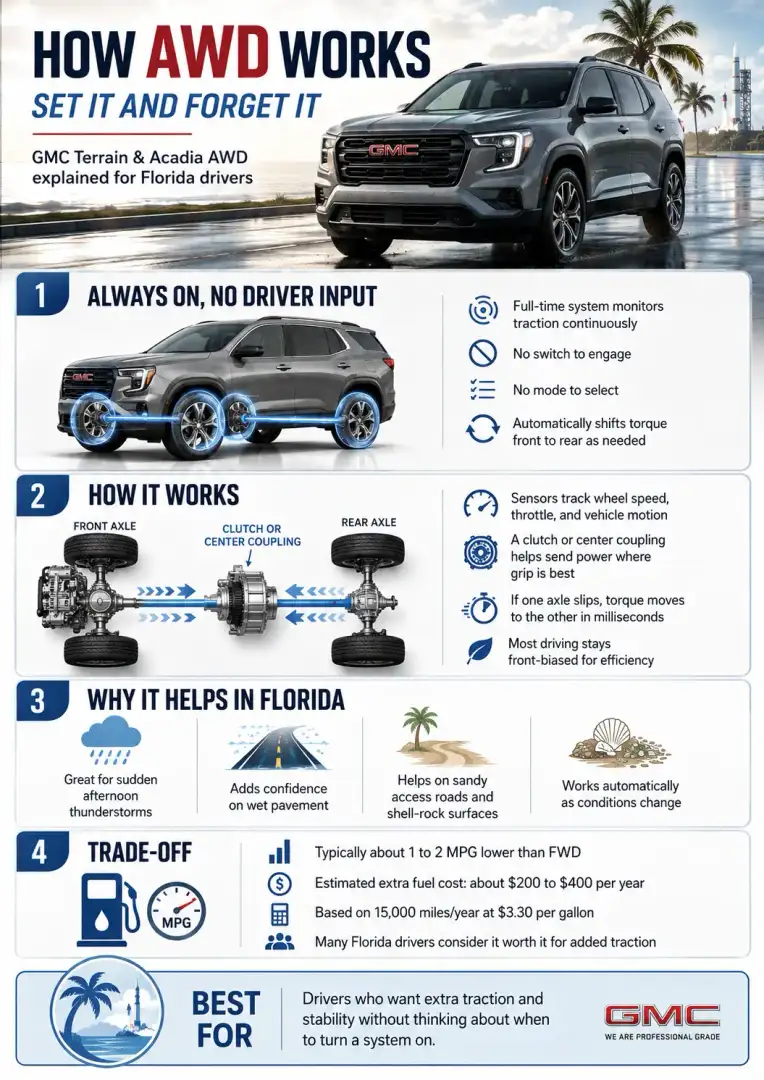
All-wheel drive in a GMC Terrain or Acadia is a full-time system that operates without any driver input. There is no switch to engage, no mode to select for AWD operation, and no sequence required to activate it when conditions change. The system monitors wheel speed, throttle position, and vehicle motion continuously and distributes torque between the front and rear axles automatically based on which wheels have the most traction at any given moment.
- The mechanical basis of AWD: a center differential or multi-plate clutch connects the front and rear axles and allows them to rotate at different speeds, important for cornering, where the inside and outside wheels need to cover different distances at different speeds. When the system detects one axle losing traction (wheel spin), it transfers torque to the other axle. This happens in milliseconds and without driver awareness. In normal dry-pavement driving, most AWD systems in GMC crossovers direct the majority of torque to the front wheels for fuel efficiency; in wet or low-traction conditions, they redistribute to maintain grip without the driver noticing the transition.
- AWD’s specific advantages for Space Coast driving: it handles wet pavement during afternoon thunderstorms automatically and continuously. Florida’s afternoon storm cycle, which can switch a dry road to a saturated one in minutes, is exactly the scenario AWD manages best because the system is already active and monitoring when conditions change. AWD in the Terrain and Acadia also improves stability on the soft shell-rock roads and sandy access paths that Brevard County’s outdoor areas involve, where the occasional loss of traction at low speed is managed automatically rather than requiring the driver to engage a system manually.
- AWD’s fuel economy trade-off: a GMC Terrain or Acadia with AWD uses approximately 1 to 2 MPG more than the equivalent FWD model because the AWD system adds mechanical rotating components that create drag even when the rear axle is providing minimal torque contribution. On a Terrain driven 15,000 miles annually at $3.30 per gallon, the fuel cost of AWD versus FWD is approximately $200 to $400 per year, a real cost, but one that most buyers in Florida’s environment consider acceptable for the traction confidence AWD provides during the state’s extended rainy season.
How 4WD Works, Driver-Selectable Power
Four-wheel drive in a GMC Sierra, Canyon, Yukon, or Sierra HD is a part-time system that the driver selects for use in specific traction-limited situations. Unlike AWD, 4WD is not active during normal driving, the default mode for a 4WD-equipped Sierra is rear-wheel drive, with the front axle disengaged. When the driver selects 4WD, the transfer case mechanically locks the front and rear axles together so they rotate at the same speed and receive equal torque.
The 4WD modes available on most GMC truck models: 2H (two-wheel high range, rear-wheel drive, for normal dry paved driving); 4H (four-wheel high range, all four wheels engaged, for slippery surfaces at normal road speeds); and 4L (four-wheel low range, all four wheels engaged at a lower gear ratio, providing maximum torque multiplication for extreme low-speed off-road situations, recovery from stuck positions, and steep grade descents). The transition between 2H and 4H can typically be made at road speed; the transition to 4L requires stopping the vehicle and moving through neutral.
The critical 4WD operating rule that every driver should know before using the system: 4H and 4L are designed for surfaces where wheel slip is occurring or is anticipated. On dry paved surfaces in 4H or 4L, the locked front and rear axles cannot rotate at different speeds for cornering, a condition called drivetrain binding that creates stress on the axles, transfer case, and tires. Driving a Sierra in 4H on dry pavement for extended distances causes mechanical wear and tire scrubbing. Use 4H and 4L on surfaces where wheel slip is possible: wet pavement, loose gravel, sand, mud, or wet grass. Return to 2H on dry pavement. This is not an inconvenience of 4WD, it is the correct use of the system’s mechanical design.
Which GMC Models Come With AWD vs 4WD
The AWD vs 4WD distinction maps to vehicle platform rather than buyer preference, GMC’s crossover SUV platform uses AWD because it is designed as a car-based platform for everyday driving, while GMC’s truck and full-size SUV platform uses 4WD because it is designed for towing, payload, and off-road capability. Understanding which platform each GMC model uses resolves the AWD vs 4WD question for that model immediately.
|
GMC Model |
Drivetrain System | Notes |
| Terrain | AWD (optional over FWD) |
Crossover platform; no 4WD option |
| AWD (optional over FWD) | Crossover platform; no 4WD option | |
| Canyon | 4WD (optional over 2WD on WT and LT; standard on Trail Boss, Z71, ZR2) |
Truck platform; 4H and 4L modes |
| 4WD (optional over 2WD on all trims) | Truck platform; AutoTrac system on most trims | |
| Sierra 2500HD / 3500HD | 4WD (optional over 2WD on Pro; standard on most trims) |
Heavy-duty truck platform |
| 4WD (optional over 2WD) | Truck-based SUV platform; 2H, 4H Auto, 4H, 4L modes | |
| Sierra EV | AWD standard (dual-motor) |
Electric drivetrain; torque vectoring at each axle |
| AWD standard (CrabWalk available) |
Electric drivetrain; independent motor per axle |
The Yukon deserves a specific note because its 4WD system includes a 4H Auto mode that many Yukon owners use as their daily mode, it behaves similarly to AWD in that it proactively monitors traction and distributes torque between front and rear before wheel slip occurs. The Yukon’s 4H Auto mode is appropriate for light to moderate traction-limited surfaces and does not create the drivetrain binding concern of 4H full-lock mode. Yukon owners who want the automatic traction management of AWD on their truck-based SUV can achieve it through 4H Auto without engaging the full mechanical lock of 4H.
Fuel Economy, Weight, and Cost Differences
The practical trade-offs between AWD and 4WD systems, in fuel economy, vehicle weight, and upfront cost, are real and worth understanding before the purchase decision. These differences compound over the ownership period and affect the total cost of ownership calculation.
- Fuel economy: AWD crossovers (Terrain, Acadia) pay approximately 1 to 2 MPG versus FWD equivalents because the AWD system adds rotating components that create parasitic drag. 4WD trucks (Sierra, Canyon) pay approximately 2 to 3 MPG versus 2WD equivalents in normal driving, the transfer case and front axle components add more rotational mass than AWD crossover components. In practical terms at 15,000 annual miles: a Sierra 1500 4WD with the 5.3L V8 uses approximately 150 to 200 additional gallons annually compared to the 2WD equivalent at $3.30 per gallon, approximately $495 to $660 in additional annual fuel cost.
- Upfront cost: AWD typically adds $1,500 to $2,500 over FWD on Terrain and Acadia models, with the precise premium varying by trim. 4WD on Sierra and Canyon typically adds $2,000 to $3,000 over 2WD, again with trim-specific variation. These premiums are one-time costs that pay back in traction confidence over the ownership period, the relevant calculation is whether the traction benefit justifies the combined fuel cost premium and upfront premium for your specific driving situation. For most Florida buyers: yes for AWD on crossovers given the annual rainy season duration; yes for 4WD on trucks for buyers who tow regularly or use the truck for actual off-road purposes; no for 4WD on trucks used exclusively on pavement.
Florida Use Cases: Beach, Rain, Off-Road, and Towing
General AWD vs 4WD guidance describes scenarios that may not match Florida’s specific terrain. The scenarios below reflect the actual driving conditions that Titusville and Space Coast GMC owners encounter, and the system that handles each one correctly.
- Wet pavement from afternoon thunderstorms, AWD or 4H Auto: The daily summer thunderstorm cycle creates wet and occasionally flooded road surfaces that benefit from any traction assistance. AWD on crossovers and 4H Auto on Yukons handle this automatically. For Sierra and Canyon owners who drive primarily on paved roads, 4H engagement on wet pavement is appropriate and provides better grip than 2WD without the drivetrain binding risk that 4H creates on dry surfaces.
- Boat ramp launches and retrievals, 4WD strongly recommended: Concrete boat ramps with algae growth, wet inclines, and the combined weight of the truck and loaded boat trailer create exactly the low-speed, high-torque, low-traction situation that 4WD is designed for. A Sierra or Canyon in 4H backing down a wet ramp with a 5,000-pound boat trailer is in its correct operating mode. A Terrain or Acadia AWD can handle this at a modest boat weight but has significantly less torque multiplication than a 4WD truck for ramps with steeper angles or heavier trailers. For owners who regularly launch at Parrish Park, Beacon 42, or Haulover Canal, 4WD is the appropriate system.
- Beach driving (where permitted), 4WD required: Soft sand at beach access areas, including the sections of Canaveral National Seashore with primitive vehicle access, requires 4L engagement for most vehicles and deflated tire pressures. AWD is typically insufficient in soft sand because the system’s automatic torque distribution cannot compensate for the load when all four wheels begin sinking. A Sierra or Canyon AT4 in 4L with tires aired down to 15-18 PSI is the correct tool. An AWD Terrain or Acadia will manage firm sand at beach access approaches but is not appropriate for extended soft-sand driving.
- Croom OHV Area and Ocala National Forest trail use, 4WD required: The unpaved trails at Croom, the forest roads in Ocala National Forest, and similar terrain require 4H for most surfaces and 4L for challenging sections. The combination of ruts, loose sand, roots, mud after rain, and grade changes creates conditions where AWD is insufficient for the lower-traction moments and 4L is the system that provides recovery capability. AT4 and AT4X trim trucks with their additional ground clearance and all-terrain tires handle Croom’s intermediate trails; the ZR2 and ZR2 Bison are appropriate for the more demanding sections.
Making the Decision: A Quick Guide by Driver Type
The driver profiles below map to the right GMC drivetrain choice for most Space Coast buyers. These are not universal rules, they are the pattern that emerges from the specific driving conditions and use cases that Titusville and Brevard County driving involves.
|
Driver Profile |
Recommended Drivetrain | Best GMC Model Match |
| Daily commuter, all paved roads, occasional rain | FWD or AWD |
Terrain FWD or AWD, Acadia FWD |
|
Family SUV, school runs, occasional boat ramp |
AWD (crossover) or 4WD (Yukon) | Acadia AWD, Yukon 4WD |
| Truck for work + weekend outdoor use | 4WD |
Sierra 1500 4WD, Canyon 4WD |
|
Regular boat towers, wet ramps, trailering |
4WD | Sierra 1500, Canyon, Yukon 4WD |
| Serious off-road: Croom, Ocala, beach | 4WD with AT4/AT4X trim |
Sierra AT4X, Canyon ZR2 or AT4X |
|
Heavy towing: commercial, large boats |
4WD with Max Trailering Package |
Sierra 1500 or 2500HD 4WD |
The profile that creates the most discussion at our dealership: the buyer who commutes on paved I-95 five days per week and launches a center console boat at Parrish Park every weekend. That buyer’s daily driving needs AWD or 4H Auto. Their weekend boat launch use needs 4WD. The practical resolution: a Sierra 1500 4WD with 4H Auto on wet-pavement commutes and 4H for the ramp. The Sierra’s 4H Auto mode functions similarly to AWD on pavement, eliminating the compromise between the two use cases. The Yukon’s 4H Auto mode provides the same resolution for buyers who need three-row family capacity alongside towing capability.
Conclusion
AWD and 4WD are not interchangeable systems, they are different technologies designed for different primary use cases. AWD on GMC’s Terrain and Acadia crossovers is an automatic, full-time system best suited for wet pavement, light unpaved surfaces, and the daily traction confidence of Florida’s rainy season. 4WD on GMC’s Sierra, Canyon, and Yukon is a driver-selectable, part-time system that provides maximum traction for boat ramp launches, off-road terrain, beach driving, and heavy towing, the scenarios where AWD’s automatic traction management reaches its limit. For most Space Coast GMC buyers, the right system is the one that matches the highest-demand scenario they regularly encounter: AWD if that scenario is wet pavement; 4WD if it is a wet boat ramp, a Croom trail, or a soft sand access road. At Starling GMC Titusville, our team can help you identify the right choice for your specific driving pattern and connect it to the right model and trim in current inventory.

0 comment(s) so far on AWD vs 4WD in a GMC: Which One Do You Actually Need?