



Best GMC SUV for Florida Families: Terrain vs Acadia vs Yukon Compared
Florida families have specific SUV needs that buyers in other parts of the country do not face in the same combination: intense heat that demands reliable air conditioning and materials that do not fade or crack, salt air exposure near the coast, hurricane season preparation that rewards cargo capacity and ground clearance, and the constant mix of school runs, beach days, and boat trips that asks a family SUV to be everything at once. GMC’s SUV lineup addresses these needs across three distinct size categories, and choosing the right one depends on matching the vehicle to how your family actually lives.
At Starling GMC in Titusville, we help Space Coast families make this decision regularly. This guide covers the Terrain, Acadia, and Yukon, GMC’s three core family SUV options, across every dimension that matters for Florida buyers. We will tell you who each vehicle is built for, where each one leads, and how to identify which one fits your specific situation.
Choosing the Right GMC SUV for Your Florida Family
The starting point for any GMC SUV decision is size, not vanity size, but the practical question of how many seats you actually need, how much cargo you regularly carry, and whether you tow. These three factors determine whether the Terrain, Acadia, or Yukon is the right foundation before any other consideration enters the picture.
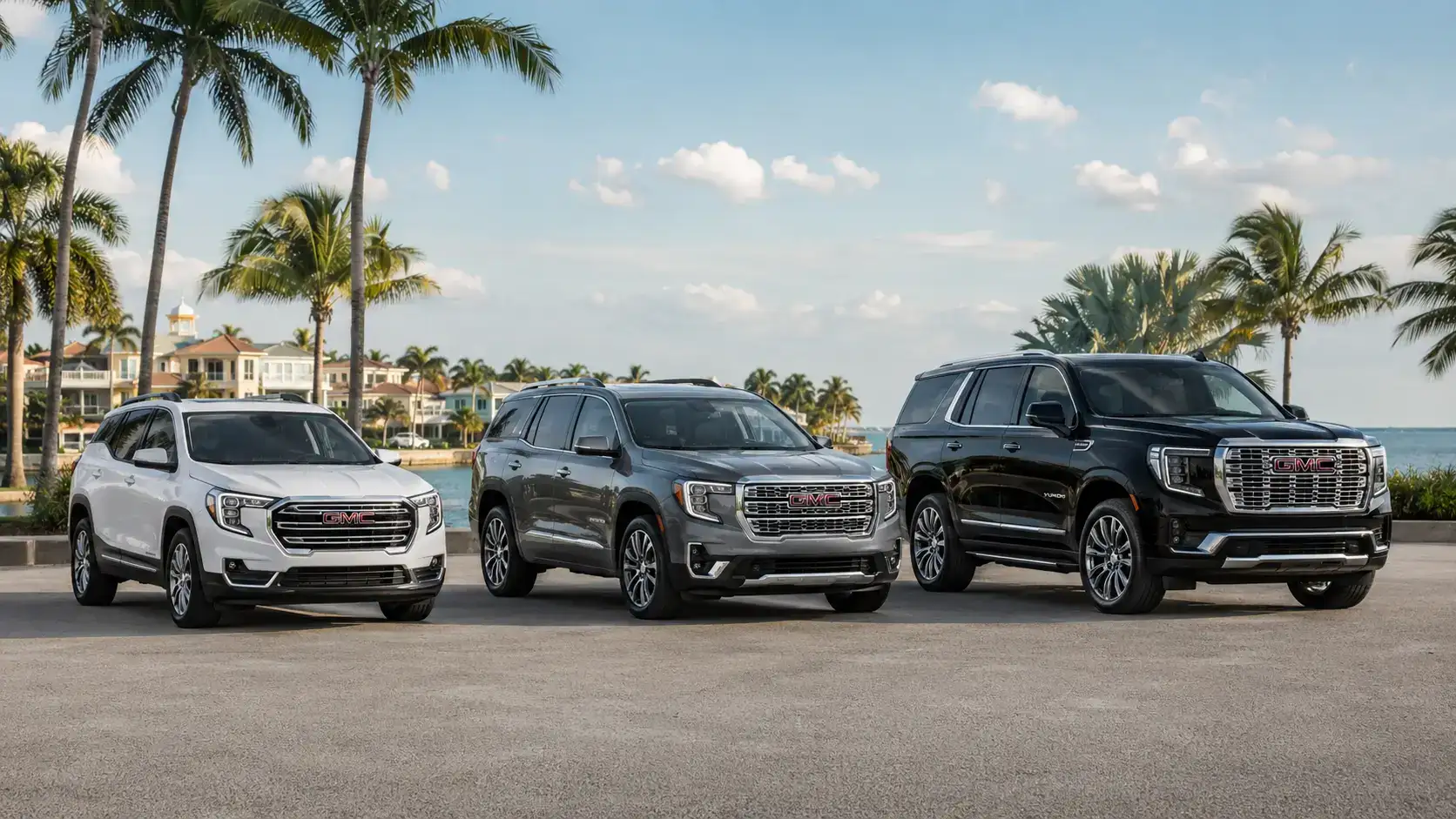
The Terrain is GMC’s compact SUV: five seats, a focused footprint that navigates Titusville’s neighborhoods and Kennedy Space Center area traffic efficiently, and the best fuel economy in the lineup. The Acadia is GMC’s mid-size three-row crossover: seven or eight seats, enough cargo to handle a family road trip, and towing capability that covers most recreational trailer and boat needs. The Yukon is GMC’s full-size body-on-frame SUV: maximum seating, maximum cargo, and the towing capacity to handle the largest boats and trailers that the Space Coast lifestyle demands.
What Matters Most for Florida Drivers (heat, cargo, beach trips, hurricane prep)
Florida’s climate imposes specific requirements that buyers coming from other states sometimes underestimate. Heat management is the first: interior surfaces that retain heat, dark materials that absorb solar radiation, and air conditioning systems that cannot keep pace with a car left in direct sun for two hours are daily frustrations in a state where summer temperatures regularly reach 95 degrees with high humidity. GMC’s standard dual-zone or tri-zone climate control across the lineup addresses this directly, and the standard tinted rear windows on all three vehicles help manage solar load. For buyers with young children in car seats, rear ventilated seats available on upper Terrain and Acadia trims make a meaningful practical difference during Florida summers.
Hurricane preparedness is a genuine consideration for Brevard County families that rarely comes up in SUV comparisons written for northern markets. Cargo capacity to load critical supplies and personal items quickly, ground clearance to navigate flooded roads, AWD capability for compromised road surfaces, and the ability to power devices via available 120V outlets or the Yukon’s available generator mode are features that have tangible value in a region where mandatory evacuation orders are part of the seasonal reality. The Yukon’s size and towing capacity also make it the vehicle for families who keep a trailer, camper, or boat that needs to move during an evacuation scenario.
At a Glance, Terrain vs Acadia vs Yukon Quick Comparison
The table below provides the verified 2026 specifications that define the practical differences between the three vehicles. All figures reflect confirmed data from GMC.com, Edmunds, US News, and CarsDirect.
The most significant differences to note before reading further: the Terrain does not offer a third row; the Acadia and Yukon both do, but the Yukon’s third row is meaningfully more comfortable for adults. The Terrain’s towing capacity is limited to 1,500 lbs AWD, appropriate for a personal watercraft but not a serious boat. The Acadia and Yukon tow 5,000 and 8,400 lbs respectively, covering the full range of recreational trailer needs.
Side-by-Side Spec Table (Size, Seating, Cargo, Towing, MPG, MSRP)
|
Specification |
2026 GMC Terrain | 2026 GMC Acadia | 2026 GMC Yukon |
| Starting MSRP | $30,200, Elevation FWD | ~$45,795, Elevation |
$69,600, Elevation |
|
Body Style |
Compact crossover | Mid-size 3-row crossover | Full-size body-on-frame SUV |
| Seating Capacity | 5 | 7 (captain’s chairs) or 8 (bench) |
Up to 9 |
|
Engine |
1.5L turbo I4 / 175 HP / up to 203 lb-ft (AWD) | 2.5L turbo I4 / 328 HP / 326 lb-ft | 5.3L V8 / 6.2L V8 / 3.0L Duramax |
| EPA MPG (FWD) | 26 city / 28 hwy / 27 combined | 20 city / 27 hwy / 23 combined |
~16-17 combined (5.3L V8) |
|
Max Towing |
800 lbs FWD / 1,500 lbs AWD | 5,000 lbs | 8,400 lbs (V8 equipped) |
| Cargo (behind 3rd row) | N/A (no 3rd row) | 23.0 cu ft (GMC.com) |
25.5 cu ft |
|
Cargo (max, all folded) |
62.8 cu ft | 97.5 cu ft | 122.9 cu ft |
| Wheelbase | 107.3 inches | 120.9 inches |
120.0 inches |
|
Top Trim |
Denali ~$41,800 | Denali Ultimate ~$64,795 |
Denali Ultimate ~$105,195 incl. destination |
GMC Terrain, The Compact Family SUV
The 2026 GMC Terrain occupies the most accessible position in GMC’s SUV lineup, the vehicle for families who want GMC quality, modern technology, and efficient daily driving without the size and cost of the larger models. Redesigned for 2026 with updated exterior styling and a revised interior featuring a 15-inch touchscreen across all trims, the Terrain is a meaningfully better vehicle than its predecessor. It is also the right-sized vehicle for a specific Florida family profile that the Acadia and Yukon simply cannot serve as efficiently.
The Terrain’s strengths in the Florida context are its fuel economy, 26 MPG city and 28 MPG highway make it the most cost-efficient vehicle in this group for the daily school run, grocery trip, and commute, and its compact footprint that makes Titusville’s parking lots, Space Coast’s beach access roads, and Kennedy Space Center area traffic genuinely easier to manage than the larger alternatives. For families who occasionally need more space, the Terrain’s 62.8 cubic feet of maximum cargo with the rear seat folded is larger than it appears.
Who the Terrain Is Best For
The Terrain is best for the Space Coast family of three to five people whose primary transportation needs are covered by five seats, who value fuel efficiency and maneuverability over towing capacity, and who want the GMC technology and safety suite without the commitment to a larger vehicle. This profile covers a significant portion of the families in Brevard County: couples with one or two children, individuals who need occasional cargo capacity but daily-drive alone or with one passenger, and buyers for whom the $30,000 entry price makes the Terrain the financially sensible choice for their situation.
The Terrain is not the right choice for families who regularly carry more than five people, who need to tow anything heavier than a personal watercraft or small trailer, or who require adult-comfortable seating in a third row. For those buyers, the Acadia is the natural next step. But for the buyer whose needs are genuinely served by a compact SUV, the Terrain delivers everything GMC does well, ProSafety driver assistance suite, Google Built-In infotainment, AT4 off-road capability on the trail trim, and Denali luxury at the top, at the most accessible price in the lineup.
Terrain Cargo Space, Seating, and Daily Practicality
The 2026 Terrain’s interior feels larger than its compact dimensions suggest, with a 15-inch touchscreen that anchors a modern cabin design and front-seat comfort that competes with larger vehicles. The rear seat provides comfortable room for two adults and manageable space for a third, adequate for school runs and family errands without the spaciousness of the Acadia or Yukon. Behind the rear seat, 29 cubic feet of cargo space is sufficient for weekly grocery runs, beach gear for two or three, and a week’s worth of luggage for a small family. With the rear seat folded, the 62.8 cubic feet of cargo space handles a trip to the big box store or a batch of hurricane prep supplies.
What the Terrain cannot do: carry more than five people, provide comfortable rear-seat accommodation for tall adults on long trips, or load beach gear for a family of five plus a dog without making choices about what stays home. These are not criticisms, they are honest descriptions of what a compact SUV is and is not. The buyer who needs those capabilities should be in the Acadia.
Terrain Engine, MPG, and Fuel Costs in Florida
The 2026 Terrain’s 1.5L turbocharged four-cylinder produces 175 horsepower and up to 203 lb-ft of torque in AWD configuration, numbers that look modest on paper but provide adequate performance for the vehicle’s intended use. Merging onto I-95 and passing on Florida’s two-lane roads are confident in FWD configuration; the AWD variant’s 8-speed automatic transmission provides slightly quicker response than the CVT used in FWD models. The EPA rates the Terrain FWD at 26 city / 28 highway / 27 combined, figures that translate to approximately $1,900 in annual fuel cost at 15,000 miles and $3.30 per gallon Florida regular. The Acadia FWD costs approximately $2,800 per year in the same scenario; the Yukon V8 approximately $3,300. The Terrain’s fuel economy advantage accumulates meaningfully over five years of ownership.
Terrain Trim Levels and Pricing
The 2026 Terrain is available in three trims: Elevation (FWD from $30,200, AWD from approximately $32,100), AT4 AWD ($39,300), and Denali AWD ($41,800) per current pricing references. The Elevation provides the technology foundation, 15-inch touchscreen, Google Built-In, GMC ProSafety standard safety suite, and wireless Apple CarPlay and Android Auto, at the entry price. The AT4 adds AWD standard, all-terrain tires, sport appearance accents, and the off-road suspension tuning that makes the Terrain capable on unpaved surfaces. The Denali delivers heated and ventilated front seats, a heated steering wheel, 8-way power driver’s seat, and the Denali exterior treatment. All trims benefit from the 2026 redesign’s visual update and revised interior.
The 2026 Terrain is available in three trims: Elevation (FWD from $30,200, AWD from approximately $32,100), AT4 AWD ($39,300), and Denali AWD ($41,800) per current pricing references. The Elevation provides the technology foundation, 15-inch touchscreen, Google Built-In, GMC ProSafety standard safety suite, and wireless Apple CarPlay and Android Auto, at the entry price. The AT4 adds AWD standard, all-terrain tires, sport appearance accents, and the off-road suspension tuning that makes the Terrain capable on unpaved surfaces. The Denali delivers heated and ventilated front seats, a heated steering wheel, 8-way power driver’s seat, and the Denali exterior treatment. All trims benefit from the 2026 redesign’s visual update and revised interior.
The GMC Acadia: The Midsize 3-Row Sweet Spot
The 2026 GMC Acadia is the three-row answer for Space Coast families who have outgrown the compact SUV category or whose lifestyle requires the combination of meaningful towing capacity, adult-usable third-row seating, and genuine cargo space that a compact SUV cannot deliver. Completely redesigned for the 2024 model year and updated for 2026 with the addition of the Denali Ultimate flagship trim, the Acadia is a more capable vehicle than many buyers who cross-shop it against the Traverse or Explorer realize, and its new standard digital rearview mirror, Google Built-In technology, and available Super Cruise hands-free driving represent a technology package that exceeds several more expensive competitors.
The Acadia’s 328 horsepower turbocharged 2.5L four-cylinder is the same engine that powers the Buick Enclave, tuned to provide confident performance across a vehicle that families will use on Florida’s interstates, school runs, and weekend trips. Its 5,000 lb towing capacity covers the overwhelming majority of recreational trailers, smaller boats, and utility needs that Space Coast families tow, making it the practical choice for buyers whose towing requirements do not approach the Yukon’s 8,400 lb ceiling.
Who the Acadia Is Best For
The Acadia is best for the Space Coast family of five to eight people who needs genuine three-row capability with an interior that works as a daily driver and a road trip vehicle simultaneously. The family that does school runs with three kids in different rows, takes weekend trips to the Gulf Coast, occasionally tows a boat or camper in the 3,000 to 5,000 lb range, and wants modern technology without the full-size truck’s fuel cost and parking footprint, that family is an Acadia buyer. The Acadia is also the vehicle for buyers who cross-shop the Yukon and find that 8,400 lbs of towing is more than they need while a five-passenger compact SUV is less than they need.
The Acadia’s new Denali Ultimate trim brings the brand’s highest-level luxury content into the mid-size three-row segment for the first time, a milestone that positions the Acadia as a genuine alternative to the Buick Enclave for buyers who want GMC’s design language over Buick’s quieter character.
Acadia Third-Row Seating and Family Comfort
The third-generation Acadia’s return to larger dimensions, it grew significantly from the downsized second-generation 2017-2023 model, directly addressed the most consistent criticism of the outgoing vehicle: the cramped third row. The 2026 Acadia’s third row provides 32.1 inches of legroom, which is adult-usable for shorter adults and comfortable for children and teenagers. The 40.2 inches of second-row legroom with captain’s chairs means middle-row passengers are not compromised to accommodate third-row entry. For families where the third row is used regularly, carpooling for sports, accommodating visiting grandparents, or carrying a full household, the Acadia’s dimensions make it a practical daily solution rather than an occasional-use layout.
The Elevation trim’s available second-row bench increases seating to eight, the highest capacity available in the non-full-size SUV category, while the AT4, Denali, and Denali Ultimate trims use captain’s chairs for seven-passenger seating with SmartSlide second-row access to the third row. Behind the third row, 23 cubic feet of cargo space is competitive with the segment; with all seats folded, 97.5 cubic feet of maximum cargo volume is one of the largest figures in any mid-size three-row crossover sold in the US market.
Acadia Engine, Towing, and Road-Trip Capability
The 2.5L turbocharged four-cylinder in the 2026 Acadia produces 328 horsepower and 326 lb-ft of torque paired with an 8-speed automatic, a genuinely strong powertrain for a vehicle of this size that provides confident merging on I-95 and relaxed highway cruising without the V8’s fuel cost. The EPA rates the FWD Acadia at 20 city / 27 highway / 23 combined, and the AWD at 19 city / 24 highway / 21 combined. For a family vehicle covering 15,000 miles annually, the FWD Acadia costs approximately $2,800 per year in fuel, between the Terrain’s $1,900 and the Yukon’s $3,300, proportionate to the vehicle’s size and capability.
The 5,000 lb maximum towing capacity, standard across all Acadia trims with the included Trailering Package, covers a 20-foot center console boat and trailer (typically 3,500 to 4,500 lbs), a small to mid-size camper, a loaded utility trailer, or a personal watercraft trailer with two PWC units. For Space Coast families who launch at Parrish Park, Beacon 42, or the various Banana River and Indian River access points, the Acadia handles the recreational towing that most of these families do with meaningful reserve capacity.
Acadia Trim Levels and Pricing
The 2026 Acadia starts at approximately $45,795 for the Elevation with destination basis depending on source, with AWD adding approximately $2,000 and the AT4 AWD starting above $54,000. The Denali starts above $57,000 and the Denali Ultimate, new for 2026, sits around $64,795 in base configuration. All trims include the 2.5L turbo engine, 8-speed automatic, standard Trailering Package, and Super Cruise availability on Elevation, AT4, and Denali, with expanded luxury content on Denali Ultimate.
GMC Yukon, The Full-Size Family Hauler
The 2026 GMC Yukon is the answer when maximum capability is the requirement, when the family has grown beyond what any crossover accommodates comfortably, when the towing requirements include a serious boat, camper, or utility trailer, or when the Space Coast lifestyle demands a vehicle that can handle evacuation-level cargo alongside everyday family duties. The Yukon’s body-on-frame architecture is not nostalgia for the past; it is the engineering foundation that enables capabilities a crossover platform cannot match, including the maximum towing, maximum payload, and the ride and handling characteristics of a true truck-based vehicle.
The 2025 Yukon received a significant update, the most comprehensive since its last-generation redesign, including an available 17.7-inch diagonal touchscreen, updated exterior styling aligned with the Sierra 1500 and Tahoe refresh, enhanced safety technology, and expanded Super Cruise availability. The 2026 continues those updates with further availability adjustments. The Yukon Elevation starts at $69,600, approximately $23,800 more than the Acadia Elevation when comparing current starting figures, and that premium reflects a genuinely different class of vehicle capability, not just a size upgrade.
Who the Yukon Is Best For
The Yukon is the right choice for the Space Coast family that regularly carries seven or more people with adult comfort expectations, tows anything above 5,000 lbs, or needs the maximum cargo capacity of any GMC SUV for hurricane prep, moving, or regular heavy hauling. It is also the vehicle for buyers who want Denali Ultimate luxury at the full-size level, Night Vision, massaging seats, 16-way power seats, AKG audio, and Super Cruise as standard, in a vehicle that can tow a 28-foot boat the same afternoon. The Yukon carries the Denali brand’s most comprehensive content expression and is the vehicle that buyers arriving from the luxury SUV market most naturally step into when they decide they need more capability.
The Yukon is not the right choice for buyers whose primary concern is fuel economy, who drive primarily in urban areas where the full-size footprint creates friction, or who can genuinely cover their family’s needs with the Acadia’s 5,000 lb towing and three rows. If the Acadia’s capability suffices, its lower price, better fuel economy, and more manageable size make it the smarter financial choice for most families.
Yukon Interior Space, Cargo, and Captain’s Chairs
The Yukon’s interior space advantage over the Acadia is most apparent in the third row, where 34.1 inches of legroom, compared to the Acadia’s 32.1 inches, creates the difference between adult-comfortable seating and seat-you-can-fit-in seating. For a family that uses the third row daily for adults rather than occasionally for children, this 2-inch difference is felt on every trip. The second row with available captain’s chairs provides 40.7 inches of legroom, and the front row’s wide, well-bolstered seats benefit from the Yukon’s full-size cabin width. Available massaging front seats on Denali trims make the Yukon a genuine long-distance comfort leader.
Behind the third row, 25.5 cubic feet of cargo space handles more grocery bags, beach gear, and daily cargo than the Acadia’s 23 cubic feet. With all seats folded, 122.9 cubic feet of maximum cargo volume, the largest in this comparison by a significant margin, enables loads that no crossover can match. For the family that needs to load everything and go during a hurricane evacuation, the Yukon’s cargo volume is not an abstraction.
Yukon Towing Capacity for Boats and Campers
The Yukon’s maximum towing capacity of 8,400 lbs, achieved with the 5.3L or 6.2L V8 and the appropriate tow package, is the largest in this comparison and covers the full range of recreational trailers that Space Coast families tow. A 24-foot boat and trailer combination at 6,500 lbs, a mid-size travel trailer at 7,000 lbs, a loaded car trailer for a weekend at Daytona, or a heavy equipment trailer for work, the Yukon handles all of these with meaningful reserve capacity. The available Duramax diesel (305 HP, 495 lb-ft) reaches 8,200 lbs towing with approximately 22 MPG combined, the most efficient powertrain for buyers who tow regularly and want to manage fuel cost while maintaining serious capability.
The Yukon’s trailering technology on SLT and above includes the ProGrade Trailering System with multiple camera views, a trailering app for iOS and Android, trailer tire pressure monitoring, and Hitch Guidance, tools that make the Yukon the most technologically supported towing experience in this comparison and one of the most complete available in any SUV.
Yukon Trim Levels and Pricing
The 2026 Yukon starts at $69,600 for the Elevation and spans to approximately $105,195 for the Denali Ultimate when using GMC build-and-price figures that include destination, a range that reflects a vehicle lineup from capable daily driver to near-luxury SUV. The SLT at approximately $82,000 is where the ProGrade Trailering System, premium leather, Bose audio, and the 17.7-inch display become central to the daily experience. The AT4 and AT4 Ultimate add serious off-road hardware and appearance content, while Denali and Denali Ultimate deliver the premium materials, 16-way front seats with massage, and available Super Cruise technology that make the Yukon feel like a direct Escalade alternative at a lower price point.
Side-by-Side Family Use Cases
Spec comparisons provide the foundation, but the decision between these three vehicles ultimately comes down to how your family actually uses a vehicle day to day, season to season, and year to year. The sections below map specific Space Coast family use cases to the vehicle that serves them best.
These are not arbitrary categorizations, they reflect the genuine capability differences between the vehicles that our team at Starling GMC observes in how Space Coast buyers actually use what they purchase.
Best for Small Families and City Driving
The GMC Terrain is the right vehicle for couples, single-parent households with one or two children, and individuals who need SUV versatility without full-size commitment. Its 26/28 MPG fuel economy saves approximately $900 per year compared to the Acadia and $1,400 per year compared to the Yukon at Florida fuel prices. Its compact footprint makes Titusville’s neighborhoods, the parking at Kennedy Space Center Visitor Complex, and the beach access roads at Playalinda genuinely easier. And its 15-inch standard touchscreen, GMC ProSafety suite, and available Denali trim deliver everything GMC does well at the most accessible price in the lineup.
Best for Growing Families and Carpools
The GMC Acadia is the right vehicle for families of four to seven who need three-row flexibility without the full-size Yukon’s footprint and fuel cost. The family whose oldest child is now in high school sports and regularly needs a third-row seat for teammates, whose weekend trips to Disney require genuine luggage space alongside passenger comfort, and whose occasional towing includes a boat trailer or camper in the 3,000 to 5,000 lb range, that family is an Acadia buyer. The Acadia’s available Super Cruise on all but the base Denali Ultimate (where it is standard) makes the I-4 run to Orlando and the Turnpike south a more relaxed trip than any comparable three-row crossover offers.
Best for Beach Days, Boating, and Towing
The GMC Yukon is the right vehicle for the family that tows a serious boat, camper, or utility trailer, who regularly carries seven or more people including adults who expect third-row legroom, and who needs the cargo capacity to handle what Florida outdoor life demands. The family with a 24-foot center console boat, a camper for weekends at Ocala National Forest, or a work trailer that needs to move on weekends is a Yukon buyer. The Yukon’s 8,400 lb towing ceiling, ProGrade Trailering System, and available Duramax diesel’s towing efficiency at 8,200 lbs cover every recreational scenario the Space Coast offers. No other vehicle in this comparison does.
Best for Hurricane Prep and Cargo Hauling
The GMC Yukon is the strongest hurricane preparedness vehicle in this comparison by a significant margin. Its 122.9 cubic feet of maximum cargo volume, nearly 30 cubic feet more than the Acadia and nearly twice the Terrain’s capacity, enables loading the household supplies, personal items, and evacuation essentials that a family of five or more needs to move quickly. The Yukon’s 8,400 lb towing capacity means the trailer, boat, or camper that needs to be relocated before a storm can be moved in the same vehicle. AWD availability on all trims means compromised road surfaces are navigable. The Denali and upper trims’ available 120V power outlets and Yukon-specific available generator mode make the vehicle a power source during post-storm situations. The Yukon is not just a family SUV, for Space Coast families, it is infrastructure.
Cost of Ownership in Florida
The price difference between these three vehicles is substantial, the Yukon costs more than twice the Terrain to buy at the base level. Understanding the five-year total cost of ownership, not just the purchase price, gives the complete financial picture for families evaluating which vehicle makes the most sense for their specific situation.
The calculations below use 15,000 annual miles, Florida regular gasoline at $3.30 per gallon, and the base engine for each vehicle. All fuel economy figures are EPA-rated.
Insurance, Fuel, and Maintenance Compared
Fuel is the most visible ongoing cost difference. The Terrain’s 27 MPG combined translates to approximately $1,833 per year in fuel at 15,000 miles. The Acadia FWD at 23 MPG combined costs approximately $2,152 per year. The Yukon 5.3L V8 at 17 MPG combined costs approximately $2,912 per year. Over five years, the Terrain saves approximately $5,400 in fuel compared to the Yukon and $1,600 compared to the Acadia, savings that partially offset the purchase price premium of the larger vehicles. Insurance costs increase with vehicle value; Florida’s insurance market rates for full-size SUVs reflect their replacement cost and theft risk, adding approximately $400 to $700 per year to the Yukon’s insurance cost relative to the Terrain in typical Brevard County profiles. Maintenance costs across all three vehicles are broadly similar for routine service intervals, with the Yukon’s V8 requiring slightly higher oil change costs.
Resale Value Across the GMC SUV Lineup
Full-size body-on-frame SUVs maintain the strongest resale values in the GMC lineup, and in the broader US market. The Yukon’s resale performance is among the best in the full-size SUV category, regularly retaining 50 to 55 percent of MSRP after five years in average-use scenarios. The Denali and AT4 trims command the strongest used-market premiums within the Yukon lineup. The Acadia’s resale is competitive within the mid-size three-row crossover segment, benefiting from the third-generation redesign’s positive reception. The Terrain’s resale is consistent with the compact SUV segment, where the volume of available used units creates more price competition than in the full-size category. For buyers who plan to trade within five years, the Yukon’s strong residual values partially offset its higher initial cost.
Which GMC SUV Is Right for Your Family? Test Drive a GMC SUV at Starling GMC Titusville
The right answer depends on three honest questions: How many seats do you actually need on a regular basis? How much do you tow, and how heavy? And what is your real annual mileage and fuel cost tolerance? If five seats cover your needs and you do not tow, the Terrain is the financially and practically smart choice. If three rows and up to 5,000 lb towing define your needs, the Acadia is the sweet spot. If your family regularly fills all rows, tows above 5,000 lbs, or needs maximum cargo capacity for what Florida’s lifestyle demands, the Yukon is the answer.
At Starling GMC in Titusville, we carry all three vehicles and can set up a comparison drive that lets you experience the size and capability differences back to back. The most useful 45 minutes in this decision process is parking a Terrain, Acadia, and Yukon side by side and understanding what each one actually delivers in your hands.
Conclusion
The GMC Terrain, Acadia, and Yukon are three distinct answers to the family SUV question, matched to three different buyer profiles defined by size needs, towing requirements, and budget. The Terrain serves the compact-SUV family with the best fuel economy, most accessible price, and GMC’s full technology suite. The Acadia serves the three-row family with the best balance of capability, technology, and value in the lineup. The Yukon serves the maximum-capability family with the segment’s strongest towing, largest cargo volume, and the full-size experience that no crossover can replicate. All three are built for Space Coast life.
Starling GMC Titusville carries all three models. Visit us at 1350 S Washington Ave or contact our team to discuss which vehicle fits your family.

0 comment(s) so far on Best GMC SUV for Florida Families: Terrain vs Acadia vs Yukon Compared