


What is Super Cruise? GMC’s Hands-Free Driving Explained
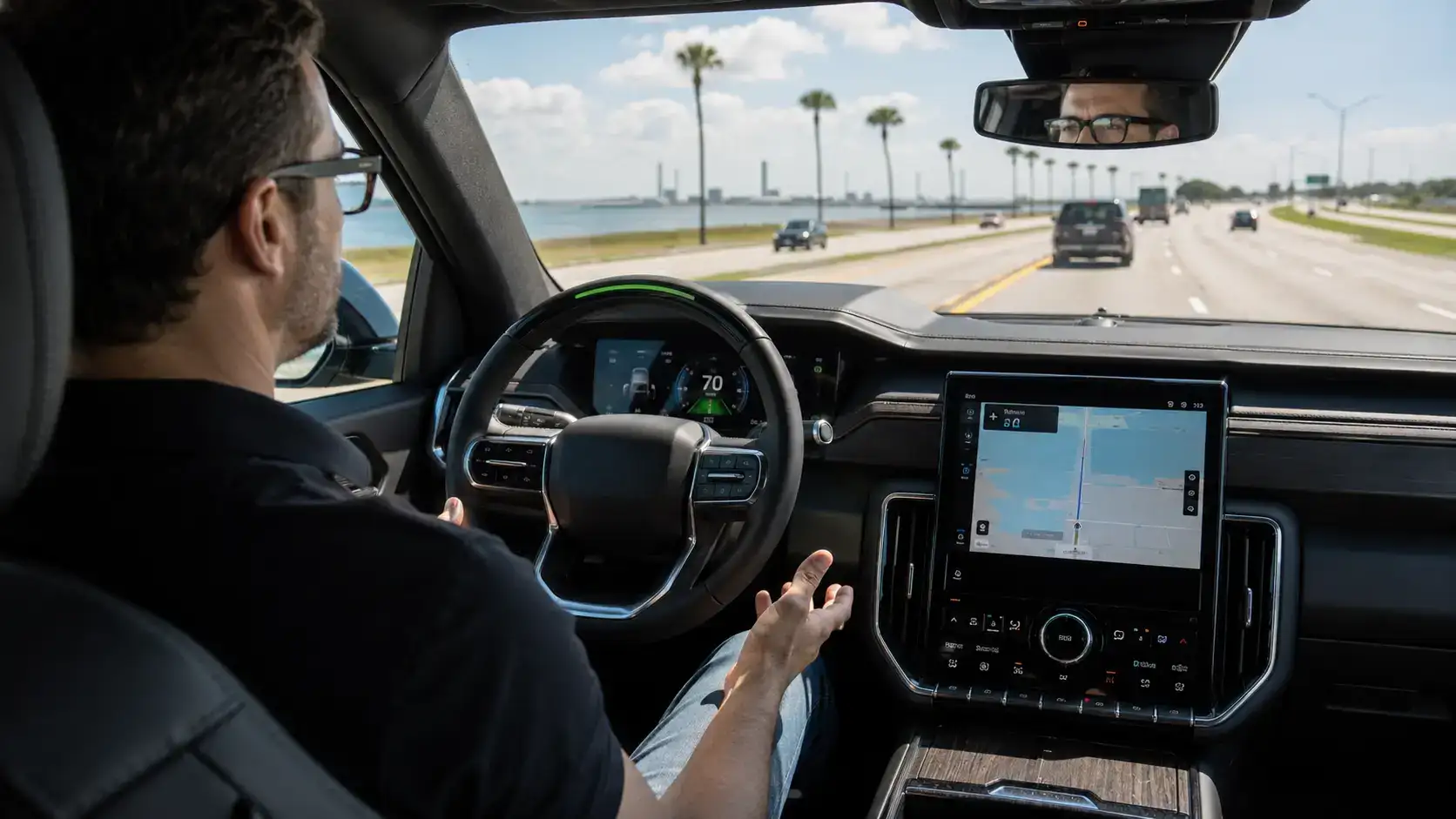
Super Cruise is the technology that separates a GMC from the competition in a way that no spec sheet fully captures until you have experienced it on the highway. It is GMC’s hands-free driver assistance system, not a parking assistant, not a lane-departure warning, not adaptive cruise control. It is a system that allows you to remove your hands from the steering wheel entirely on compatible divided highways while the vehicle steers, accelerates, and brakes to maintain your lane and following distance. Your hands are on your lap. The truck is driving itself on the highway.
At Starling GMC in Titusville, we can demonstrate Super Cruise on a real test drive that includes a stretch of I-95, which runs directly through Titusville and is Super Cruise compatible from Miami to Jacksonville. That demonstration is more convincing than any description. But for buyers who are evaluating whether Super Cruise is worth the trim level it requires or the subscription it involves, this guide gives you every factual detail you need to make that decision clearly.
What Super Cruise Actually Does (In Plain English)
Super Cruise is the first true hands-free driver assistance system available on compatible highways in a production vehicle, a distinction that matters because every hands-free claim in the auto industry before Super Cruise’s 2018 debut required periodic hands-on-wheel contact to confirm driver engagement. Super Cruise does not. It uses a driver-facing infrared camera rather than wheel contact sensing, which is the engineering decision that enables genuine hands-free operation.
The system manages three simultaneous functions when active: lateral control (steering to maintain the center of the lane), longitudinal control (accelerating and braking to maintain the set following distance from the vehicle ahead), and driver attention monitoring (confirming that the driver’s eyes are directed toward the road ahead through the infrared camera). All three functions operate simultaneously and are interdependent, the steering and speed management only continue as long as the driver attention monitoring confirms eyes-forward attention. This is not a workaround or a loophole in the hands-free claim. It is the system design: hands off the wheel, eyes on the road.
What Super Cruise is not: it is not self-driving, it is not a crash-avoidance system, and it does not replace driver judgment or responsibility. The driver remains legally and practically responsible for the vehicle’s operation at all times. Super Cruise is a Level 2 driver assistance system, the same category as adaptive cruise control and lane centering, elevated to the point where hands-off operation is genuinely possible on qualified roads. When the road ends its compatible segment, when the system encounters conditions it cannot handle confidently, or when the driver’s attention monitoring fails to confirm eyes-forward attention, the system requests driver re-engagement through a progressive alert sequence before handing back control.
Which GMC Models Come With Super Cruise in 2026
Super Cruise is available across several 2026 GMC models, but not across the full lineup and not across all trims of any model that offers it. Understanding exactly where it appears, and where it does not, is the foundation for making a trim and model decision with Super Cruise as a factor.
The availability pattern reflects GMC’s positioning of Super Cruise as a premium technology reserved for the premium tier of each model’s lineup. With the exception of the Hummer EV, where Super Cruise is standard across configurations given the vehicle’s flagship pricing, Super Cruise lives at the Denali tier and above in every GMC model that offers it.
GMC Model Super Cruise Availability Standard or Available?
Super Cruise is available across several 2026 GMC models, but not across the full lineup and not across all trims of any model that offers it. Understanding exactly where it appears, and where it does not, is the foundation for making a trim and model decision with Super Cruise as a factor.
The availability pattern reflects GMC’s positioning of Super Cruise as a premium technology reserved for the premium tier of each model’s lineup. With the exception of the Hummer EV, where Super Cruise is standard across configurations given the vehicle’s flagship pricing, Super Cruise lives at the Denali tier and above in every GMC model that offers it.
|
GMC Model |
Super Cruise Availability | Standard or Available? |
| Sierra 1500 | Denali, Denali Ultimate |
Available on Denali; standard on Denali Ultimate |
| Denali, Denali Ultimate | Available on Denali; standard on Denali Ultimate | |
| Sierra EV | Elevation, AT4, Denali |
Available on Elevation; standard on AT4 and Denali |
|
Yukon / Yukon XL |
Denali, Denali Ultimate | Available on Denali; standard on Denali Ultimate |
| Acadia | Denali, Denali Ultimate |
Available on Denali; standard on Denali Ultimate |
| AT4, Denali | Available on both AT4 and Denali | |
| Hummer EV Pickup | Both trims (2X and 3X) |
Available upgrade on both |
| Both trims | Standard | |
| Terrain | Not available |
Not offered on any Terrain trim |
The important distinction for Sierra 1500 buyers considering an AT4 or AT4X: Super Cruise is not available on the AT4 or AT4X trim of the Sierra 1500. Those trims’ off-road hardware package and the Denali’s technology and luxury package are designed for different buyer priorities, and Super Cruise is reserved for the Denali tier. Buyers who want both the AT4X’s Multimatic DSSV dampers and locking differentials and Super Cruise will need to evaluate the Sierra EV’s AT4, the electric Sierra that offers Super Cruise at the AT4 trim level. For the gasoline Sierra 1500, Super Cruise requires stepping to Denali.
OnStar subscription requirement: every Super Cruise-equipped GMC requires an active OnStar plan to access the Super Cruise feature. Qualifying new GMC vehicles with Super Cruise come with a 3-year complimentary OnStar trial that activates from first use, providing the full Super Cruise capability, compatible road network access, all available features, and over-the-air road network updates, at no additional cost during the trial period.
How to Use Super Cruise: A Simple 3-Step Activation
Super Cruise’s activation sequence is simpler in practice than it sounds in description, and buyers who have never used a hands-free driving system typically get comfortable with the process within the first 20 minutes of use. The system is designed to be intuitive, the same driver attention that makes you a safe driver in any car is the same attention Super Cruise monitors and rewards with continued operation.
The three-step activation assumes you are already driving on a Super Cruise-compatible highway at a speed appropriate for the system’s operation. Super Cruise will not activate on city streets, at intersections, in construction zones, or on unmapped divided roads regardless of driver input.
Steps to activate
Step 1, Turn on Adaptive Cruise Control: Super Cruise operates on top of Adaptive Cruise Control, so ACC must be active first. Set your desired speed and following distance as you would with standard ACC. The vehicle is now managing your speed and following distance but still requires hands on the wheel.
Step 2, Wait for the white Super Cruise steering wheel icon: When the vehicle determines that all conditions for Super Cruise operation are met, compatible road confirmed by GPS, LiDAR map data validated, driver attention camera calibrated, sensors clear, a white Super Cruise icon appears on the instrument cluster. This white icon means the system is ready and available but not yet active. The transition from ACC to Super Cruise-ready typically takes 30 to 60 seconds after entering a compatible highway segment.
Step 3, Press the Super Cruise button on the steering wheel: The dedicated Super Cruise button on the Sierra, Yukon, and Acadia steering wheel activates the system. The light bar on the steering column transitions from white to green. Green means go, the system is active, your hands can leave the wheel, and Super Cruise is managing steering, speed, and driver attention monitoring simultaneously.
The light bar color sequence is the primary driver feedback mechanism: white indicates Super Cruise is ready and available; green indicates Super Cruise is active and hands-free operation is confirmed; blue indicates the system is requesting that you take control, typically at the end of a compatible highway segment, before an exit, or when conditions change. Red and flashing indicates an urgent request to take control immediately. The progressive nature of the alert sequence, white to green to blue to red, is designed to be unambiguous and to provide appropriate lead time before driver re-engagement is required.
The 400,000+ Miles of Compatible Roads (Including I-95 Through Titusville)
Super Cruise’s compatible road network is built on a foundation of High-Definition LiDAR mapping, the same technology used in autonomous vehicle development, applied to a defined and growing network of divided highways across the United States and Canada. When GM first launched Super Cruise on the 2018 Cadillac CT6, the compatible road network started at approximately 400,000 miles of pre-mapped divided highway, covering the major interstate and US highway network across North America. That original 400,000-mile foundation is the network that defined Super Cruise as the first hands-free system with sufficient road coverage to be genuinely useful for American highway drivers.
The network has grown substantially since that launch through over-the-air software updates delivered to Super Cruise-equipped vehicles. New roads are added to the compatible network as GM’s LiDAR mapping program surveys, validates, and integrates additional highway segments, a process that has extended Super Cruise’s reach beyond the original major interstate coverage to include secondary highways, additional US routes, and connector roads between markets that were previously outside the network. Vehicles receive these network additions through OTA updates automatically, meaning a Super Cruise-equipped Sierra purchased today receives every compatible road added to the network during the ownership period at no additional cost.
For Titusville and Space Coast GMC owners, the locally relevant Super Cruise-compatible road is I-95, and it runs directly through our backyard. I-95 is fully compatible from Miami to Jacksonville, covering the full length of Florida’s east coast interstate corridor. The Titusville stretch of I-95 is compatible, meaning that a Sierra Denali owner leaving Starling GMC Titusville and merging onto I-95 southbound toward Melbourne or northbound toward Daytona is within seconds of Super Cruise-compatible territory. The Florida Turnpike is also compatible through its full Florida length, covering the route south to Miami and north toward Orlando. For Space Coast residents who run these corridors regularly, Super Cruise’s compatible road coverage is not a theoretical benefit, it is operational on the specific roads driven most frequently.
What Super Cruise Won’t Do, And When You Have to Take Over
The most useful section of any Super Cruise guide is the one most dealer articles skip: the honest description of what the system will not do and when driver re-engagement is required. Buyers who understand both the capabilities and the limitations arrive at a realistic expectation of the ownership experience, which produces higher satisfaction than buyers who assume Super Cruise is more capable than it is and are surprised by its boundaries. These are not criticisms, they are accurate descriptions of a system designed with specific intent and appropriate safety boundaries.
Super Cruise will not handle highway exits. When your navigation route calls for an exit from a compatible highway, Super Cruise provides advance notice and requests driver re-engagement before the exit begins. This is by design, the exit ramp, the deceleration lane, and the non-highway road that follows are not compatible segments, and Super Cruise’s appropriate response is to hand control back to the driver with sufficient time to manage the transition. Plan for a brief manual driving period at every exit or when transitioning between compatible highway segments. Super Cruise does not navigate construction zones. Active work zones with altered lane configurations, temporary markings, and barriers that deviate from the LiDAR map data cause Super Cruise to disengage and request driver control. This is another appropriate safety design decision, construction zone driving requires dynamic judgment that the current system’s mapped-road architecture is not designed to handle.
Super Cruise is not a crash-avoidance system. It manages speed and following distance to maintain a set gap from the vehicle ahead, but it is not a collision mitigation system independent of driver attention. The driver attention monitoring system is the safety mechanism that ensures a driver is present and aware, Super Cruise is not designed to operate without driver supervision. Rain, fog, snow, or anything that obscures the road lane markings or the driver attention camera can cause Super Cruise to disengage. In Florida’s afternoon thunderstorm conditions, Super Cruise may disengage during heavy precipitation, appropriate behavior that the driver should anticipate on summer driving days. These limitations do not diminish Super Cruise’s genuine utility on the roads and in the conditions where it operates. They define the system accurately so buyers know what they are getting.
Super Cruise vs Tesla Autopilot and Ford BlueCruise
Three systems define the hands-free highway driving market in 2026: GMC’s Super Cruise, Tesla’s Autopilot/Full Self-Driving, and Ford’s BlueCruise. All three are Level 2 driver assistance systems, all three require driver attention and readiness to intervene. The meaningful differences between them are in road coverage approach, driver monitoring method, and the operational characteristics that determine daily usefulness.
Super Cruise leads on mapped-road coverage and driver attention monitoring approach. The LiDAR-mapped compatible road network, built on specific pre-validated highway data, provides consistent, reliable hands-free operation on every mile it covers. The driver attention camera’s infrared monitoring, which works in low light and with sunglasses on, is more consistent than systems that require periodic steering wheel touch to confirm engagement. Super Cruise’s capability to operate while towing a compatible trailer is unique in the category, Ford BlueCruise and Tesla Autopilot/FSD do not function with a trailer attached. For GMC Sierra and Yukon owners who tow regularly and make long highway trips with a trailer, Super Cruise’s towing-compatible hands-free operation is a material capability advantage that neither competitor provides. Super Cruise’s compatible road network also supports hands-free lane changes on qualifying roads through Lane Change on Demand, driver activates the turn signal, Super Cruise confirms the target lane is clear and executes the lane change while maintaining hands-free operation.
Tesla’s Full Self-Driving (Supervised) leads on urban and non-highway coverage. FSD operates on city streets, handles intersections, responds to traffic signals, and navigates in environments where Super Cruise and BlueCruise do not operate at all. For buyers whose primary hands-free need is urban and suburban driving rather than highway driving, Tesla’s camera-based neural network approach covers more situations. The trade-off is consistency, Super Cruise’s mapped-road approach is more predictable and reliable on the roads it covers; FSD’s neural network approach works in more scenarios but with more variability in behavior. Ford’s BlueCruise is the closest peer to Super Cruise in approach and capability, also a mapped-road hands-free system, also requiring driver attention monitoring, also focused on highway use. BlueCruise’s road network coverage and driver monitoring system are both competitive with Super Cruise. The meaningful practical difference: Super Cruise’s towing compatibility and its longer operational history with more real-world refinement in the hands-free highway category. Super Cruise averages over 40 million hands-free miles driven per month nationally across all equipped vehicles, a scale of real-world operation that has informed continuous improvement in the system’s reliability and behavior.
Experience Super Cruise on a Test Drive at Starling GMC
The only way to fully understand Super Cruise’s value is to experience it on a test drive that includes a live, hands-off stretch of highway, and Starling GMC Titusville is uniquely positioned to provide exactly that. Our location at 1350 S Washington Ave puts us minutes from I-95, which is Super Cruise-compatible for its full Florida length. A test drive that includes a northbound or southbound I-95 run gives you the real hands-off, green-light-bar experience that no description or video accurately conveys.
Our sales team will walk you through the three-step activation on the test drive, let you experience the driver attention camera monitoring firsthand, and demonstrate the light bar sequence that communicates system status. Starling GMC was recognized as a 2025 GMC Dealer of the Year, a credential that reflects our commitment to product knowledge and customer experience. When you ask about Super Cruise, our team knows the system from direct experience with it, not from a brochure. Visit us at 1350 S Washington Ave in Titusville to schedule your Super Cruise test drive on a Sierra Denali, Yukon Denali, or Acadia Denali. If you are in the market for a Sierra EV AT4 or Denali where Super Cruise comes standard, we can discuss current allocation as well.
Conclusion
Super Cruise is the most capable hands-free highway driving system available in the GMC lineup, and for Space Coast drivers who regularly run I-95 through Titusville, it is available on the specific road they drive most. It is not self-driving and not a substitute for driver attention. It is a genuine hands-free highway driving system built on pre-mapped LiDAR road data, a driver attention camera that monitors eyes rather than hands, and an over-the-air expanding road network that started at 400,000+ compatible miles and has grown since launch. It comes with a 3-year complimentary trial on qualifying GMC vehicles. It works while towing a compatible trailer, a capability no competitor in the category offers. And it is available on the Sierra 1500 Denali and Denali Ultimate, Yukon and Yukon XL Denali and Denali Ultimate, Acadia Denali and Denali Ultimate, Canyon AT4 and Denali, Sierra EV, and the Hummer EV lineup.
Visit Starling GMC at 1350 S Washington Ave in Titusville to experience it firsthand.

0 comment(s) so far on What is Super Cruise? GMC’s Hands-Free Driving Explained