




GMC Yukon vs Yukon XL: Which Full-Size SUV Length Is Right for You?
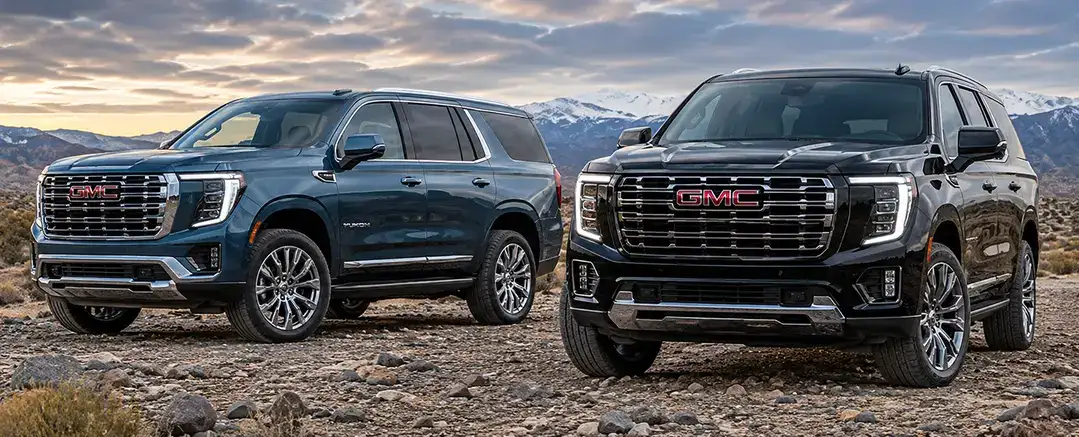
The main difference: 15.1 inches that change everything
The question we hear most often at Starling GMC Titusville when a customer walks in to look at Yukons is this: what is the real difference between the Yukon and the Yukon XL? The direct answer is 15.1 inches of overall length. GMC’s own specifications put the Yukon at 210.1 inches and the Yukon XL at 225.2 inches.
Almost everything else is shared between the two. Same engines, same trim levels, same technology, same equipment, and a consistent price gap. The decision is about size and what that extra size buys you inside the vehicle. If you already know which engine you want or which trim interests you, that does not change between the Yukon and the XL. What changes is how much you can carry with everyone aboard, how comfortable the third row is on a long drive, and how easy the vehicle is to live with day to day in Brevard County.
Cargo space: where the XL truly makes a difference
The number that matters most to most families is the space behind the third row with all seats in use. This is where the XL’s extra length pays off: GMC lists 25.5 cubic feet behind the third row in the standard Yukon and 41.5 cubic feet in the Yukon XL. That is 16 additional cubic feet, or roughly 63 percent more usable cargo space with the whole family inside.
In real terms on the Space Coast, that difference decides whether you make one trip or two. In the standard Yukon with all three rows occupied, you can fit the grocery run or the beach chairs, but not both at once. In the XL you can fit two large coolers plus fishing gear, or four full-size suitcases plus carry-ons for a flight out of Orlando Melbourne International.
The gap narrows as you fold seats down, which is worth knowing if your third row is usually empty. Behind the second row, GMC lists 72.5 cubic feet in the Yukon against 93.6 in the XL. With the second and third rows folded flat, maximum cargo capacity runs about 122.9 cubic feet in the Yukon and 144.7 in the XL. So the XL’s advantage is largest in the configuration most families actually drive in, with everyone aboard, and smallest when the vehicle is being used as a two-seat hauler.
| Cargo configuration | Yukon | Yukon XL | XL advantage |
|---|---|---|---|
| Behind the third row (all seats up) | 25.5 cu. ft. | 41.5 cu. ft. | +16.0 cu. ft. |
| Behind the second row | 72.5 cu. ft. | 93.6 cu. ft. | +21.1 cu. ft. |
| Maximum, all rows folded | ~122.9 cu. ft. | ~144.7 cu. ft. | +21.8 cu. ft. |
Engines and towing: the same engines, slightly different limits
One of the things that most surprises buyers comparing the Yukon and Yukon XL for the first time is that the engine lineup is identical. There is no XL-exclusive engine and no engine reserved for the standard wheelbase. All three are offered on both, each paired with a 10-speed automatic.
| Engine | Power / torque | Availability |
|---|---|---|
| 5.3L V8 | 355 hp / 383 lb-ft | Standard on Elevation and AT4 |
| 6.2L V8 | 420 hp / 460 lb-ft | Standard on AT4 Ultimate, Denali and Denali Ultimate |
| 3.0L Duramax Turbo-Diesel | 305 hp / 495 lb-ft | Available across all trims |
Towing is where the two body styles genuinely differ, and the reason is weight: the XL carries more of its own, which leaves less margin for a trailer. GMC lists the Yukon’s maximum at up to 8,400 pounds when properly equipped with the available trailering technology. In GMC’s published figures the XL comes in slightly lower at every engine and drivetrain combination, typically by 100 to 300 pounds depending on configuration.
For the great majority of Brevard County families towing a boat, a pair of Jet Skis or a mid-size camping trailer, a 100 to 300 pound difference will never be the limiting factor. Both body styles carry far more capacity than that use requires. Where it does matter is at the margins: if you regularly tow close to the vehicle’s rated maximum, the standard Yukon has the technical edge, and that edge gets larger once you also load the cabin, because passengers and cargo count against the same total. If you need to combine serious towing with a full house and full luggage, the honest answer is to work out the actual numbers with our team rather than reading a single headline figure, and the towing capacity for any specific vehicle depends on its engine, drivetrain and equipment. The GMC Yukon capability page and the trailering section of the owner’s manual are the authoritative references for a given build.
Pricing: a consistent $3,000 difference
Pricing is the easiest part of this comparison to understand, because the XL carries a flat premium rather than a sliding one. GMC’s published starting prices confirm it at the entry point in both current model years: for 2026, the Yukon starts at $69,600 and the Yukon XL at $72,600. For 2027, the Yukon starts at $70,200 and the XL at $73,200. Both are exactly $3,000 apart.
Here are GMC’s published starting MSRPs by trim for the 2026 model year, which is the year most likely to be on our lot at a discount right now, with the XL premium applied:
| Trim (2026) | Yukon starting MSRP | Yukon XL |
|---|---|---|
| Elevation | $69,600 | $72,600 |
| AT4 | $76,600 | +$3,000 |
| Denali | $80,400 | +$3,000 |
| AT4 Ultimate | $97,900 | +$3,000 |
| Denali Ultimate | $103,900 | +$3,000 |
Starting MSRP as published by GMC, excluding destination freight charge, taxes, title, license and dealer fees. Confirm the current figure for the exact trim and configuration you want, and note that AT4 and AT4 Ultimate come standard with four-wheel drive while the other trims offer both two- and four-wheel drive.
Framed that way, the decision is reasonably clean. Are 16 extra cubic feet behind the third row, and nearly two additional inches of third-row legroom, worth $3,000? For a large family that regularly travels with every seat filled, especially one that runs I-95 north on holidays or hauls water sports gear, the answer is usually yes without much deliberation. For a smaller household, or one that puts a premium on maneuverability in parking lots, the standard Yukon may deliver everything they need for less.
Parking, handling and the reality of Florida garages
At 225.2 inches, the Yukon XL is just over 18 feet 9 inches long. In a standard 20-foot residential garage that leaves roughly 15 inches of total clearance, front and rear combined, which in practice means a handful of inches at each end once the vehicle is centered. That is enough to close the door, but not enough to leave bicycles against the back wall or to walk comfortably around the nose. If your garage has an automatic door with a sensor near the threshold, or anything stored at the far end, measure before you commit to the XL rather than after.
If you live in a Titusville, Rockledge or Merritt Island neighborhood with narrow streets or tight cul-de-sacs, the XL’s larger turning circle is a real daily factor. Parking near Cocoa Beach is notoriously tight in season and on launch days around Cape Canaveral, and the standard Yukon is meaningfully easier to place in those spaces.
On the other hand, if you already drive a full-size truck such as a Sierra 1500, the adjustment to an XL is minor. The 15.1-inch difference makes itself felt mainly when reversing into a space or maneuvering in a tight lot, far less on the open road.
Technology and features: the same on both
Worth emphasizing: the equipment list does not change between the Yukon and the Yukon XL. There are no XL-exclusive features and nothing omitted from the standard wheelbase. Configure a Denali Ultimate in either body style and you get the same displays, the same driver assistance systems, the same Bose audio and the same safety content.
Where equipment does change is by trim rather than by length. Super Cruise, GMC’s hands-free driver assistance technology for compatible highways, is the clearest example: for the 2026 model year GMC lists it as standard on the AT4 Ultimate and Denali Ultimate and available on the Elevation, AT4 and Denali. If hands-free driving on I-95 matters to you, that is a trim decision, not a Yukon-versus-XL decision. You can read more on the GMC Super Cruise page.
This parity makes the choice easier. You do not have to give up technology to get the larger vehicle, and you do not have to pay for content you do not want in order to get the size you need. The $3,000 difference covers the dimensions and the cargo space, nothing else. Warranty coverage and maintenance intervals are also identical between the two body styles, though the specific terms differ by engine, so check the warranty booklet for the vehicle you are buying rather than assuming a single figure across the lineup.
Third-row seat comfort: a real but measured difference
Third-row space is one of the most frequently misunderstood differences between these two vehicles, usually in the direction of exaggeration. The honest numbers: GMC lists 34.9 inches of third-row legroom in the standard Yukon and 36.7 inches in the Yukon XL. That is a difference of 1.8 inches.
Both are genuinely usable for adults, which is not true of every three-row SUV in this price range, and 34.9 inches in the standard Yukon is a perfectly reasonable seat for a school run or a trip across the causeway. The 1.8 inches do become noticeable on a long drive, and for families whose third row is routinely occupied by grown teenagers or grandparents on multi-hour trips, that margin is worth having. But the standard Yukon does not have a token third row, and anyone telling you adults cannot sit back there is overstating it.
The more consequential third-row difference is not legroom, it is what sits behind it. In the standard Yukon, families with more than five people often end up folding the third row to create cargo room, which effectively limits the vehicle to five seats on trips with luggage. In the XL, you can keep all three rows up and still have 41.5 cubic feet behind them. That changes the practical calculation far more than 1.8 inches of legroom does.
Who should buy the Yukon XL? Who should stick with the standard Yukon?
Choose the Yukon XL if: you have a family of seven or more and need everyone to travel with luggage aboard; adults sit in the third row regularly on long drives; you tow and also carry significant equipment inside; you take frequent road trips where the extra cargo space changes the experience; or you already drive large vehicles and the size does not concern you when parking.
Choose the standard Yukon if: your household is five or fewer and the Yukon’s cargo space covers your needs; you frequently park in multi-story garages, shopping centers or tight urban spaces; you tow close to the vehicle’s rated maximum and want every pound of capacity; you prioritize maneuverability over maximum cargo volume; or home parking is tight enough that 15 inches would make a daily difference.
The good news is that you do not have to make this call on paper. Both body styles are available at Starling GMC Titusville to drive yourself, and the difference in the cargo area is far more obvious with the tailgate open in front of you than it is in a specification table.
Visit Starling GMC Titusville and compare both in person
We keep inventory of both the Yukon and the Yukon XL in multiple trims so you can compare them side by side at our location. Our team can walk you through both vehicles, show you the real cargo difference with the seats configured different ways, run the towing numbers against what you actually pull, and answer the specific questions that apply to your family.
You can browse current Yukon and Yukon XL inventory on our site, or visit us at 1350 S Washington Ave in Titusville. We serve buyers throughout Brevard County, including Titusville, Cocoa, Rockledge, Merritt Island and the surrounding Space Coast.
Conclusion
The GMC Yukon and Yukon XL are the same vehicle with one meaningful variable: 15.1 inches of length, which translate into 16 additional cubic feet of cargo space behind the third row, 1.8 inches more third-row legroom, and a $3,000 price difference. The engines, trims, technology and equipment are identical, and towing capacity is marginally higher on the standard Yukon rather than the XL.
The right answer depends entirely on your life: how many people you carry, how often you need all that cargo capacity with everyone aboard, how close to the towing limit you operate, and how much the extra 15 inches costs you in a Brevard County parking space. If you are unsure, the simplest solution is also the best one: come to Starling GMC Titusville and drive both. Twenty minutes in each will tell you more than any specification table.
Frequently asked questions about the GMC Yukon and Yukon XL
How much longer is the GMC Yukon XL than the standard Yukon?
15.1 inches. GMC’s published specifications put the standard Yukon at 210.1 inches of overall length and the Yukon XL at 225.2 inches. That is the only dimension that separates the two body styles, and everything the XL offers over the standard Yukon follows from it.
Are the engines different between the Yukon and the Yukon XL?
No. Both body styles offer the same three engines, each with a 10-speed automatic: the 5.3L V8 at 355 horsepower and 383 lb-ft, standard on the Elevation and AT4; the 6.2L V8 at 420 horsepower and 460 lb-ft, standard on the AT4 Ultimate, Denali and Denali Ultimate; and the 3.0L Duramax Turbo-Diesel at 305 horsepower and 495 lb-ft, available across all trims. The engine decision is independent of whether you choose the Yukon or the XL.
How much more does the Yukon XL cost than the standard Yukon?
$3,000. GMC’s published starting prices confirm the gap at the entry point in both current model years: for 2026 the Yukon starts at $69,600 and the Yukon XL at $72,600, and for 2027 the Yukon starts at $70,200 and the XL at $73,200. Starting prices exclude destination freight, taxes, title, license and dealer fees, so confirm the current figure for the specific trim and configuration you want.
Does the Yukon XL fit in a standard residential garage?
Usually yes, but with little room to spare. At 225.2 inches the XL is just over 18 feet 9 inches long, which leaves roughly 15 inches of total clearance in a standard 20-foot garage, front and rear combined. That is enough to close the door but not enough to store anything against the back wall or to walk comfortably around the nose. If your garage has a door sensor near the threshold or anything stored at the far end, measure before buying rather than after.
Which has better towing capacity, the Yukon or the Yukon XL?
The standard Yukon, by a small margin, because the XL carries more of its own weight and that leaves less for a trailer. GMC lists the Yukon’s maximum at up to 8,400 pounds when properly equipped, and in GMC’s published figures the XL comes in slightly lower at every engine and drivetrain combination, typically by 100 to 300 pounds. For most Florida use, such as a boat or a mid-size camping trailer, that difference will never be the limiting factor. It matters only if you regularly tow close to the rated maximum, and it matters more once the cabin is also loaded, because passengers and cargo count against the same total.
Is the third row in the standard Yukon usable for adults?
Yes. GMC lists 34.9 inches of third-row legroom in the standard Yukon and 36.7 inches in the Yukon XL, a difference of 1.8 inches. Both are genuinely usable for adults, which is not true of every three-row SUV at this price. The 1.8 inches become noticeable on a long drive, so families whose third row routinely carries grown passengers on multi-hour trips benefit from the XL. The larger practical difference is what sits behind the third row: 25.5 cubic feet in the Yukon against 41.5 in the XL.

0 comment(s) so far on GMC Yukon vs Yukon XL: Which Full-Size SUV Length Is Right for You?