




Florida Summer Car Care: AC, Coolant & Heat Survival Guide for Your GMC
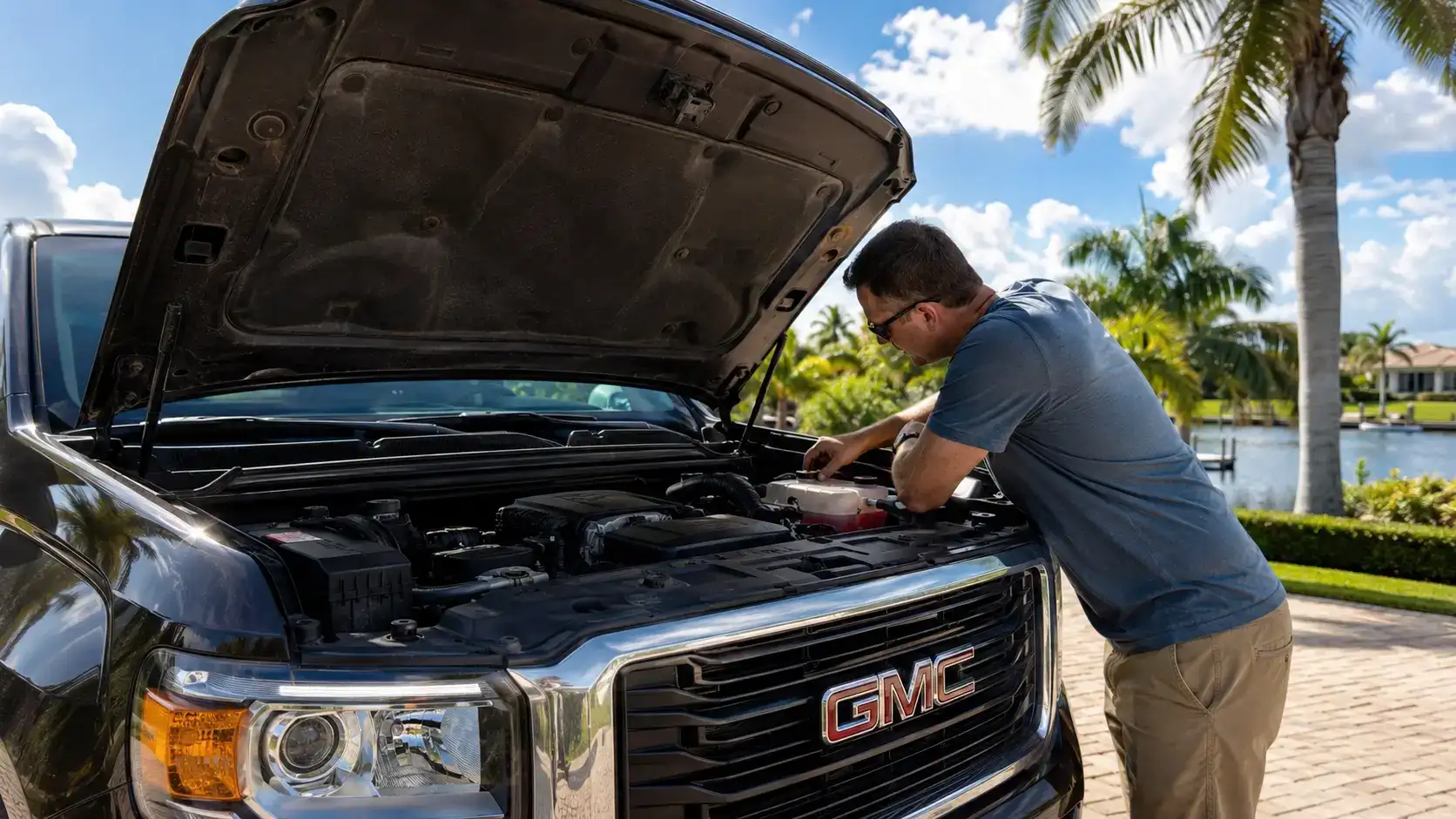
Summer maintenance in Florida is not the same conversation as summer maintenance anywhere else. The checklist that a GMC dealer in Atlanta or Dallas would give you is a reasonable starting point, but it underestimates every failure mode that Titusville and the Space Coast amplify. Your GMC operates in an environment where ambient temperature exceeds 95 degrees Fahrenheit on most days from June through September, cabin temperatures reach 130 degrees or more when the vehicle is parked in direct sun, relative humidity regularly tops 80 percent, salt air from the Atlantic and Indian River Lagoon attacks every exposed metal and rubber surface, and afternoon thunderstorms can drop two inches of rain in 45 minutes on roads that were dry an hour earlier.
The vehicles that perform reliably through this environment are not the ones that received national-average maintenance. They are the ones whose owners understood that Florida puts specific systems under specific stress, and addressed those systems specifically. At Starling GMC in Titusville, our service team sees the full pattern of what fails on Space Coast GMC vehicles and when. This guide is what that experience produces in writing: a practical, specific summer maintenance guide for GMC owners in Brevard County and the surrounding area.
What Florida Heat Actually Does to Your Vehicle
Understanding the mechanisms behind the heat damage described in this guide is the foundation for understanding why these maintenance steps matter more here than in other markets. Florida’s heat does not just make the cabin uncomfortable, it accelerates the chemical and physical degradation of specific vehicle components in ways that are predictable, measurable, and preventable with appropriate service intervals.
The four primary mechanisms are: thermal cycling, which stresses rubber and plastic components through repeated expansion and contraction; UV radiation, which degrades rubber, plastic, and paint surfaces at a rate that has no equivalent in any non-sunbelt climate; ambient temperature elevation, which reduces the efficiency margin in cooling, electrical, and lubrication systems; and salt air corrosion, which attacks metal and electrical components in coastal environments at accelerated rates. Every maintenance recommendation in this guide addresses one or more of these mechanisms specifically.
95°F+ Ambient, 130°F+ Cabin, Humidity, Salt Air, and Afternoon Thunderstorms
The numbers are worth stating concretely because they describe operating conditions that most maintenance schedules were not written for. An ambient temperature of 95 degrees Fahrenheit means that your GMC’s cooling system is managing engine heat against an ambient baseline that is 35 degrees higher than the 60-degree ambient that national average maintenance intervals assume. Every component that generates heat, the engine, the brakes, the transmission, the AC compressor, operates with 35 fewer degrees of ambient thermal headroom. Cabin temperatures of 130 degrees Fahrenheit, which are common in a Space Coast vehicle parked in direct sun for four to six hours, stress the interior materials, electronics, and the battery’s thermal management system in ways that northern owners simply do not experience. The combination of 80 percent relative humidity and salt air creates a corrosion environment for underbody components, electrical connectors, and AC condensers that is among the most aggressive in the continental United States. And the afternoon thunderstorm pattern, sudden, intense, and frequent from May through September, creates hydroplaning risk on roads that dry drivers have been traveling at highway speed without weather consideration.
Your GMC’s AC System, The #1 Thing to Check First
The AC system is the first thing to address in any Florida summer maintenance conversation because it is the system that fails most frequently under sustained high-demand operation, whose failure most directly affects safety and quality of life, and whose early-stage issues are most detectable with simple observation before they become expensive repairs. A GMC whose AC system is functioning at 90 percent capacity in March will typically reach the point of inadequate cooling sometime between May and July, at exactly the moment when the cooling demand peaks.
The Florida-specific compounding factor: your GMC’s AC system rarely gets meaningful rest during the peak months. The compressor may cycle off briefly when the cabin cools to set temperature, but the compressor hours accumulated in a year of Florida ownership are roughly double what the same vehicle would accumulate in a temperate-climate market. That compressor hour count accelerates the wear progression on seals, bearings, and refrigerant charge integrity in ways that the national 100,000-mile service interval does not capture.
Signs of a Weakening AC: Weak Airflow, Warm Air at Idle, Musty Smell, and When to Get Pro Service
Weak airflow that has diminished over several months indicates a clogged cabin air filter, an evaporator that has accumulated debris, or a blower motor that is beginning to lose efficiency. The cabin air filter is the most common and most overlooked cause, in Florida’s environment, with its high pollen load, coastal particulate, and humid air that carries debris efficiently, cabin air filters clog faster than in dry climates. A cabin air filter replacement costs $20 to $40 in parts and takes 5 to 10 minutes on most GMC models. It is the highest-return, lowest-cost AC maintenance action available and should be on a 12,000-mile or annual interval in Brevard County. Warm air at idle, the system blows cold at highway speed but warms noticeably at a stop, is almost always a condenser airflow issue. The condenser is the front-mounted heat exchanger that requires airflow to dissipate heat from the refrigerant. At highway speed, the forward motion provides that airflow. At idle, the condenser fans provide it, and if those fans have reduced output due to a motor issue or blocked airflow path, the system loses efficiency specifically when idling. This is a service center diagnosis rather than a DIY item. Musty smell from the vents indicates microbial growth on the evaporator core, a surface that accumulates moisture from normal AC operation and can harbor mold and bacteria in Florida’s humidity when the system does not fully dry out. An evaporator cleaner treatment is available at the service center and is appropriate annually for high-use Florida vehicles. When to schedule professional service: refrigerant charge that is low (cool but not cold air), clicking or grinding from the compressor area, the system cycling on and off rapidly rather than maintaining steady operation, and any refrigerant smell inside the cabin. All of these warrant a service center visit before the issue progresses to a more expensive failure.
Cooling System and Coolant Checks
The cooling system is the second-highest priority in Florida summer maintenance after the AC, and for the same reason: it is managing heat in an environment that provides significantly less ambient thermal headroom than national maintenance intervals assume. A GMC’s cooling system that operates reliably at 85-degree ambient temperature may experience thermal stress events at 95-degree ambient that produce visible degradation in coolant quality, hose condition, and radiator cap integrity over the course of a summer.
The two most commonly overlooked failure points in the cooling system, as opposed to the obvious coolant level check, are the radiator hoses and the radiator cap. Both are inexpensive to replace and are the cause of a disproportionate number of the overheating events that strand GMC owners on Brevard County roads during summer.
Coolant Level, Concentration, the 5-Year Flush Rule, Hoses and Radiator Cap
- Coolant level: check the overflow reservoir with the engine cold, verify the fluid is between the MIN and MAX marks, and note the color. GM’s Dex-Cool extended-life coolant is orange-red when fresh and properly maintained. Brown or rust-colored coolant indicates contamination from corrosion or from mixing with incompatible coolant types and signals that a flush is overdue. Green coolant in a GM vehicle indicates that the original Dex-Cool has been replaced with a conventional coolant, which is not inherently wrong but does require a different service interval.
- Concentration: Dex-Cool should be mixed 50/50 with distilled water for optimal freeze and boilover protection. In Florida, where freeze protection is irrelevant, some owners run higher water ratios for better heat transfer, but this also reduces corrosion protection. Maintain the 50/50 ratio unless a technician has recommended otherwise for your specific application. The 5-year flush rule: GM recommends a Dex-Cool flush at 5 years or 150,000 miles, whichever comes first. Florida heat degrades coolant chemistry faster than cooler climates, and 5 years is the maximum interval regardless of mileage in our market. If you do not know when the coolant was last flushed, schedule a test and flush as part of your summer service.
- Hoses: Inspect radiator and heater hoses for softness, mushiness, cracking at the ends where they attach to fittings, and any visible swelling or bulging. Hoses that are pliable when cold and properly firm when warm are healthy. Hoses that are extremely hard, cracking on the outer surface, or soft and spongy anywhere along their length should be replaced before the peak summer heat season.
- Radiator cap: The radiator cap is a pressure valve that maintains the cooling system at the correct operating pressure. A cap that no longer holds pressure effectively causes the coolant to boil at a lower temperature, reducing the system’s thermal margin precisely when that margin is most needed. Caps are inexpensive and are frequently skipped in service inspections. Ask for it specifically at your next service visit.
Battery, Tires, and Wipers, The Florida Summer Trio
These three components share a common characteristic in the Florida context: they all degrade from the same combination of UV radiation, heat cycling, and accelerated wear that Florida’s climate produces in every vehicle. And all three are components where failure happens suddenly after a period of gradual degradation that was detectable in advance, meaning that the driver who checks them proactively avoids the scenario, and the driver who waits for obvious failure symptoms experiences the failure at the worst possible moment.
The battery, tires, and wipers also share the characteristic that their replacement is relatively inexpensive compared to the consequences of failure. A battery replacement costs $200 to $350 installed. A tire failure at highway speed has consequences that are in a different category entirely.
Heat Kills Batteries Faster Than Cold, The 3-Year Florida Rule; Tire Pressure Math at 95°F; UV Destroys Wipers
- Battery, the 3-year Florida rule: In cold climates, batteries often die because cold reduces the chemical reaction rate that produces current, stranding drivers on cold mornings. In Florida, the mechanism is different and faster: heat accelerates electrolyte evaporation inside the battery, increases internal sulfation, and degrades the separator plates that maintain cell integrity. The result is a battery that loses capacity from the inside, often while continuing to start the vehicle normally until it suddenly cannot. The national guidance of replacing batteries at five years is too conservative for Florida, vehicles operated primarily in Brevard County should treat three years as the planning horizon, with a load test at three years and replacement based on test results rather than waiting for a failure symptom.
- Tire pressure at 95°F: tire pressure increases approximately 1 PSI for every 10 degrees Fahrenheit of temperature increase. A tire inflated to 35 PSI when cold on a 75-degree morning will read approximately 37 PSI after sitting in a Titusville parking lot in direct sun on a 95-degree afternoon. More importantly, the tire inflated to 35 PSI on that same cold morning may read 32 PSI the following morning after the temperature drops overnight, underinflated by 3 PSI, which is enough to meaningfully affect handling and increase the heat buildup in the sidewall during highway driving. Check tire pressure at the same time of day, consistently, when the vehicle has been parked overnight and before the first drive of the day. This gives you the cold inflation pressure that the door-jamb specification is based on.
- UV and wipers: Florida’s UV index regularly reaches 11 (extreme) during summer months, the highest category. Wiper rubber exposed to this UV intensity degrades from the outside, cracking and hardening on the contact surface, even when the wipers are in use regularly. A wiper blade that has been on a vehicle for 18 to 24 months in Brevard County is typically due for replacement regardless of how many miles the vehicle has covered. Replace wiper blades annually at minimum, or when they begin streaking or skipping in normal rain rather than waiting for the first tropical weather event to discover they are inadequate.
Salt Air and the Space Coast Wash Rule
Titusville’s position adjacent to the Indian River Lagoon and within a few miles of the Atlantic creates a salt air environment that accelerates corrosion on every exposed metal and electrical surface of your GMC. This is a qualitatively different maintenance consideration from what inland Florida owners face, and it is one that is frequently underestimated by owners who moved to the Space Coast from other parts of Florida or from out of state.
Salt air corrosion operates continuously, not just when the vehicle is near the water, but whenever coastal air is moving, which is most of the time in Titusville’s geography. The corrosion targets brake lines, suspension components, the AC condenser (front-mounted and directly exposed to forward airflow), underbody electrical connectors, exhaust system components, and the paint and clearcoat on body panels.
Why Coastal Brevard GMC Owners Need to Wash 2–3× More Often, Undercarriage Care, and AcDelco-Recommended Practice
The wash frequency recommendation for Space Coast GMC owners is 2 to 3 times per month during the summer season, compared to the once-a-month or less frequency appropriate in non-coastal markets. The rationale is direct: salt deposits accumulate on the vehicle surface continuously from salt air exposure, and rainfall does not remove them effectively, rain actually wicks salt into crevices and accelerates corrosion when it carries dissolved salt from the exterior surface into seams and gaps. A proper wash with a thorough rinse, including wheel wells and undercarriage spray, physically removes salt deposits before they can complete the corrosion process. For GMC Sierra pickup owners who use the truck bed for work or recreation near the water: rinse the bed after any saltwater or salt-spray exposure. The painted steel bed surface and the spray-on bedliner material on AT4 and AT4X models both maintain their integrity much longer with regular rinsing than without. AcDelco-recommended practice for coastal vehicles includes the application of a quality paint sealant or ceramic coating that creates a barrier between the paint surface and the salt air environment, reducing the frequency and intensity of corrosion that reaches the base metal. Our service team can recommend the appropriate products for your GMC’s specific paint system. Undercarriage care: a thorough undercarriage wash at least once per month, more frequently if the vehicle is regularly near the water or driven on roads that carry salt spray, is the single most effective action for preserving the suspension, brake line, and underbody component integrity over the ownership period. Ask for an undercarriage wash at every service visit at Starling GMC.
DIY vs Bring It to Service, A Simple Decision Table
Florida GMC owners should understand which summer maintenance items are appropriate for home or driveway completion and which ones require certified GMC service technicians and equipment. The distinction is not about technical skill, it is about the equipment required, the safety implications of errors, and the warranty considerations that apply to certain GM vehicle systems.
The table below is organized as a practical decision guide: if the item appears in the left column, you can address it yourself with basic tools and consumer products. If it appears in the right column, schedule a service appointment at Starling GMC.
|
Handle It Yourself |
Bring It to Starling GMC Service |
| Cabin air filter replacement (most GMC models: 5–10 min, no tools) |
AC refrigerant recharge, leak detection, and compressor diagnosis |
|
Windshield wiper replacement |
Cooling system flush and coolant replacement |
| Tire pressure check and inflation adjustment |
Battery load test and replacement |
|
Exterior wash including undercarriage rinse |
Brake fluid inspection and replacement |
| Interior UV protectant application on dashboard and trim |
Tire rotation and wheel alignment |
|
Windshield washer fluid refill |
Transmission fluid inspection and service |
| Visual inspection of hoses and belts (do not remove) |
Suspension and steering component inspection |
|
Air freshener / evaporator deodorizer spray (consumer products) |
Full AC system performance test and evaporator cleaning |
One practical note on cabin air filter replacement: on most current GMC models, Sierra, Acadia, Terrain, Yukon, the cabin air filter is accessible behind the glove box door by removing a retaining clip or from under the hood near the cowl. No tools are required and the replacement takes under 10 minutes. The filter is available at any auto parts store for $15 to $40. This is the single highest-value DIY maintenance action for Florida GMC owners and the one most commonly deferred unnecessarily to a service appointment.
Book Your Summer Inspection at Starling GMC Titusville
Starling GMC’s service department at 1350 S Washington Ave in Titusville is the Space Coast’s dedicated GMC service facility, staffed with GM-certified technicians who work exclusively on GMC and are familiar with the specific failure patterns and maintenance priorities that Brevard County’s climate creates. A comprehensive summer inspection covers every item in this guide in a single appointment, battery load test, AC performance check, coolant condition and level, hose and belt inspection, tire condition and pressure, wiper assessment, and a multi-point inspection that includes underbody component review.
Schedule your summer inspection now, before July’s heat peak creates the appointment demand that follows every summer in a coastal Florida market. For current service appointment availability, contact our service department directly or visit us at 1350 S Washington Ave. Your GMC will tell you what it needs, our technicians speak the language.
Conclusion
Florida summer maintenance is not the same conversation as maintenance anywhere else, and the Space Coast’s specific combination of heat, humidity, UV intensity, and salt air makes Titusville-area GMC owners some of the most maintenance-demanding customers in the country, not because the vehicles are unreliable, but because the environment is genuinely more demanding than what national service intervals account for. The priorities are clear: AC system health first, cooling system second, battery on the three-year Florida rule, annual wiper replacement, consistent tire pressure monitoring accounting for temperature swings, and a washing frequency that matches the salt air exposure your vehicle experiences. Address these items now, before summer’s peak, and your GMC will handle what Brevard County’s climate demands of it.
Book your summer inspection at Starling GMC, 1350 S Washington Ave in Titusville. Our service team is ready.

0 comment(s) so far on Florida Summer Car Care: AC, Coolant & Heat Survival Guide for Your GMC