




GMC Dashboard Warning Lights Explained: Red, Yellow & What to Do
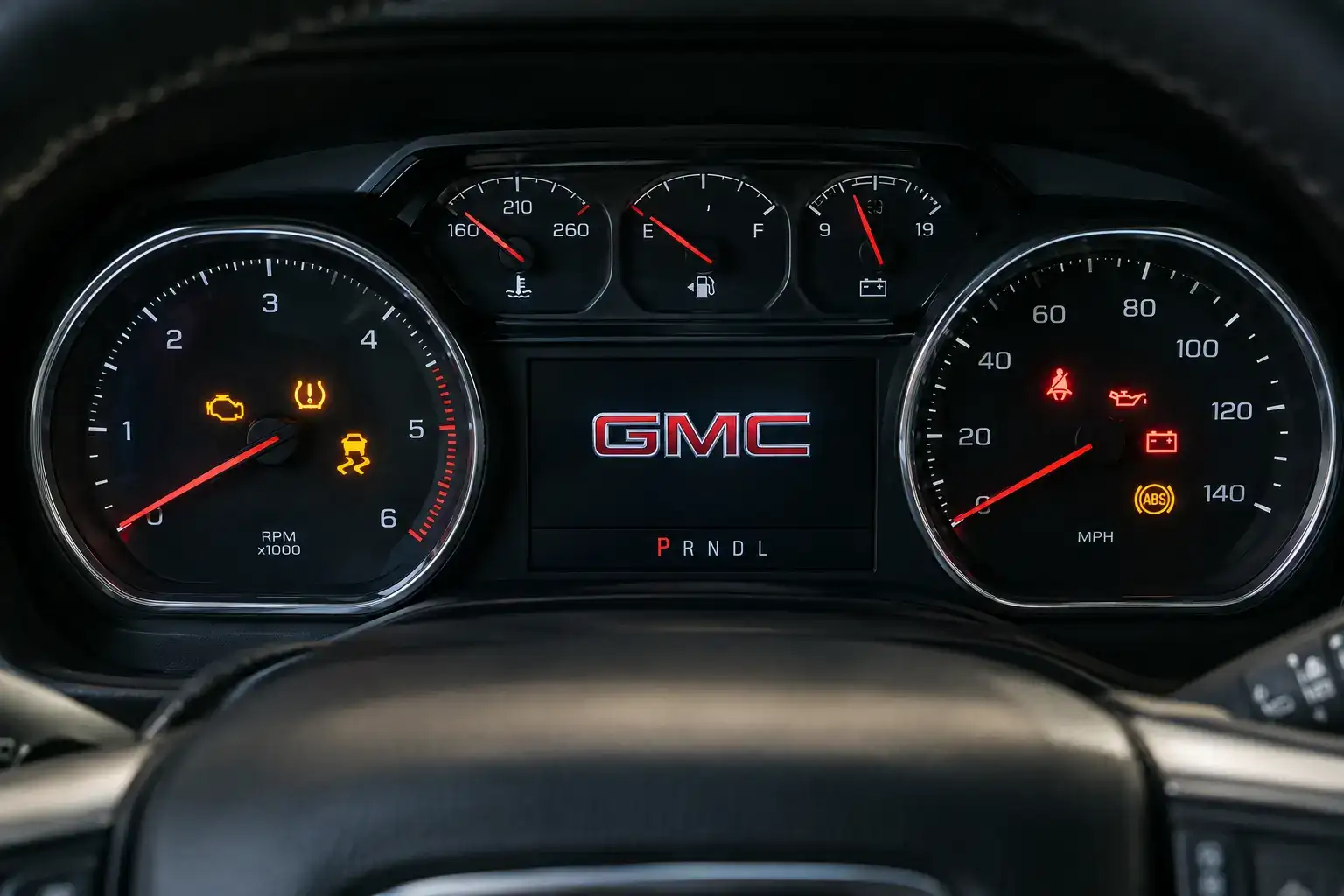
The GMC Stoplight System: Red, Yellow, Green at a Glance
Your GMC’s instrument cluster is not trying to confuse you. Once you understand the logic behind it, the dashboard becomes something closer to a conversation, one your truck is having with you about what it needs. GMC, like most major automakers, organizes warning lights around a traffic-light system that tells you immediately how urgently you need to act.
Red lights mean stop, not eventually, not when it is convenient. Red indicates a condition that, if ignored, is likely to cause serious mechanical damage or create a safety risk within minutes to hours. When a red light comes on while you are driving, your first move is to pull to a safe location and figure out what it is telling you before continuing. Yellow and amber lights mean caution, the system has detected something that needs attention, but you are not in immediate danger and can typically drive to a shop. Green, blue, and white lights are informational, they confirm that a system is active and working as intended, from your turn signal to Super Cruise. The goal of this guide is to tell you exactly what each light means and, more importantly, what to do the moment it appears.
Red Warning Lights: Stop Now
The oil pressure warning light, typically a red icon shaped like a small oil can, is one of the most serious lights your GMC can display. Low oil pressure means the engine’s moving parts are not receiving adequate lubrication. When metal components run dry, the friction and heat generated can destroy bearings, cylinder walls, and camshafts in a matter of minutes. If this light activates while driving, pull over as soon as it is safe to do so, shut the engine off, and check the oil level with the dipstick. If the oil level is normal and the light remains on after restart, do not drive the vehicle, have it towed. Running an engine with confirmed low oil pressure is how a $200 problem becomes a $5,000 engine replacement.
The brake system warning light signals that something is wrong with the hydraulic braking system. This can range from low brake fluid (which itself signals either a leak or worn pads) to a failure in the brake booster or ABS module. If the parking brake is fully released and this light is on, treat it as an emergency. Your ability to stop may be compromised. The coolant temperature warning light, typically a thermometer icon in red, means the engine is overheating. In Florida’s summer heat, this can happen faster than in cooler climates, especially in stop-and-go traffic with the AC running at full capacity. Pull over, let the engine cool for at least 30 minutes before opening the radiator cap, and check the coolant level. Continuing to drive an overheating engine is one of the most expensive mistakes a truck owner can make, it risks warping the cylinder head, cracking the block, or blowing the head gasket, all of which can cost $3,000 or more to repair.
The battery or charging system warning light indicates that the alternator is not producing enough power to keep the battery charged while the engine runs. When this light comes on, you are operating on whatever charge remains in the battery, which might be 20 minutes or 45 minutes of driving time before the truck shuts down. Get to a shop quickly. The airbag SRS warning light means there is a fault in the supplemental restraint system. Your airbags may not deploy in the event of a collision. This is not a “drive it a few more days” situation, schedule service immediately.
|
Red Light |
What It Means | What to Do |
| Oil Pressure | Engine losing lubrication |
Pull over immediately, shut off engine |
|
Brake System |
Hydraulic brake fault | Stop safely, call for service |
| Coolant Temp | Engine overheating |
Pull over, let cool 30+ min |
|
Battery/Charging |
Alternator not charging | Drive directly to shop |
| Airbag SRS | Restraint system fault |
Schedule service immediately |
Yellow and Amber Warning Lights: Get It Checked Soon
The check engine light is the most misunderstood warning light on any vehicle. It is triggered by the truck’s onboard diagnostic system detecting a reading outside of the expected range from one of hundreds of sensors. A steady check engine light means there is a stored fault code that a technician can read with a diagnostic scanner in about 15 minutes. It could be something as minor as a loose gas cap or as significant as a failing catalytic converter, the light itself does not tell you which. A flashing check engine light is a different situation entirely. A flashing light indicates an active misfire, combustion is failing in one or more cylinders, and unburned fuel is being pushed into the exhaust and catalytic converter. Continue driving with a flashing check engine light and you risk destroying your catalytic converter, which is a $1,500 to $2,500 repair. When the check engine light flashes, reduce your speed, avoid heavy throttle, and get to a shop the same day.
The ABS warning light indicates a fault in the antilock braking system. Normal braking still works, you have full hydraulic brake pressure, but if you brake hard enough to lock the wheels, the ABS will not intervene to prevent skidding. In Florida’s frequent afternoon rain, that matters. Get it diagnosed within a few days. The traction control and Electronic Stability Control (ESC) warning lights, when illuminated continuously (not just briefly when the system is working), indicate a fault in the stability management system. In wet conditions, which are common in Brevard County eight months of the year, an inactive stability system increases the risk of loss of control during hard cornering or sudden maneuvers.
The tire pressure monitoring system (TPMS) warning light, a cross-section view of a tire with an exclamation point, is one of the most commonly triggered lights in Florida, and not always because something is actually wrong. Florida’s temperature can swing dramatically between a cool morning and a hot afternoon, and tire pressure changes approximately 1 PSI for every 10 degrees Fahrenheit of temperature change. A truck parked overnight in 65-degree air and driven into 90-degree heat can see tire pressure fluctuate enough to trigger the TPMS light and then clear on its own. Check your tire pressures with a gauge when they are cold, before the first drive of the day. GMC recommends 35 PSI on most Sierra configurations; check the sticker inside the driver’s door jamb for your specific vehicle. If pressures are correct and the light persists, the TPMS sensor in one of the wheels may have failed.
Green, Blue, and White Lights: Systems Working
Most of the lights in this category are confirmations, not warnings. Your left or right turn signal indicator flashes green when the corresponding turn signal is activated, if it flashes rapidly, one of your exterior bulbs has likely failed. Cruise control illuminates a green or white icon when the system is set and active. High-beam headlights display a blue indicator. These are normal, expected lights that confirm a system is running.
The Super Cruise light bar is worth explaining specifically, because GMC’s hands-free system has a multi-color indicator built into the top of the steering wheel rather than in the instrument cluster, and the cluster icon matches its color. The single rule that matters: never take your hands off the wheel unless the bar is green. When the bar is off, Super Cruise is not active. Solid green means Super Cruise is steering the vehicle and your hands can come off the wheel, though your eyes stay on the road. Pulsing blue means Super Cruise is engaged but you are still steering and the system is not; center the vehicle in the lane and hold steady until the bar turns green. Flashing green is the first attention alert, meaning the system has detected that you may not be watching the road ahead. Flashing red, together with a solid red icon and a pulse from the safety alert seat or an audible tone, is the second alert: take steering control immediately. The system cannot continue under the current conditions, the vehicle will begin to coast, and if you do not take over it will steer and brake gradually to a stop.
If you have Super Cruise on your Sierra, Yukon, or other GMC model, the light bar colors become muscle memory quickly. The key one to remember: hands come off only on green, and red means hands back on the wheel, now.
The Florida Heat Lights You’ll See Most Often
Titusville and the broader Brevard County area have specific weather patterns that make certain warning lights more common than they would be in other parts of the country. Understanding this helps you distinguish a normal Florida phenomenon from an actual problem.
Battery warning lights appear more frequently in Florida because heat is the primary killer of automotive batteries, and the Space Coast’s high summer temperatures accelerate the internal chemical degradation that reduces battery capacity. A battery that would deliver four or five years of reliable service in a northern climate typically gives out in two to three years here. If your battery warning light activates and your battery is approaching the two-year mark, the most likely diagnosis is a battery that has simply reached the end of its Florida service life. This is a $150 to $250 fix, not a crisis.
TPMS alerts are extremely common in Florida’s temperature-variable seasons. Brevard County mornings in October and November can be in the high 60s while afternoon temperatures reach the mid-80s, a 20-degree swing that directly affects tire pressure readings. The TPMS light coming on during your morning commute and clearing by mid-day is a Florida phenomenon, not a mystery. Check pressures when cold; if they are correct, the light can be cleared by driving a few miles with properly inflated tires.
Coolant temperature warnings spike in August and September, which are the hottest months on the Space Coast. Heavy traffic, maximum AC demand, and ambient temperatures regularly in the low 90s combine to put the cooling system under sustained stress. If your coolant temperature light activates during a long idle in traffic, shift to park and let the engine idle freely without AC for a few minutes, this allows the cooling fan to work more efficiently. If the temperature does not drop within five minutes, pull to safety.
AC system warnings, including refrigerant pressure alerts, are more common in Florida simply because the AC system runs nearly year-round at higher duty cycles than virtually anywhere else in the country. Low refrigerant pressure, evaporator issues, and compressor wear all show up as dashboard warnings or degraded cooling performance. If your AC noticeably loses cold output, especially combined with a warning light, have the system inspected before the next summer season.
Can I Keep Driving? A Quick Decision Guide
The most practical question when a warning light appears is always the same: do I need to stop right now, or can I get to a shop? Here is the decision framework:
|
Light Color |
System | Decision |
| Red | Oil Pressure |
Pull over immediately, do not continue |
|
Red |
Coolant Temp | Pull over, let engine cool before moving |
| Red | Brake System |
Stop carefully, call for service |
|
Red (exception: keep driving, but straight to a shop) |
Battery/Charging | Drive directly to nearest shop, clock is ticking |
| Red | Airbag SRS |
Safe to drive; schedule service immediately |
|
Yellow |
Check Engine (flashing) | Reduce speed, drive to shop today |
| Yellow | Check Engine (steady) |
Drive to shop within a few days |
|
Yellow |
ABS | Drive carefully, avoid hard braking, service soon |
| Yellow | TPMS |
Check tire pressures when cold, may be normal in FL |
|
Yellow |
Traction/ESC | Service within a week, avoid wet-road hard driving |
| Green (flashing) | Super Cruise |
Attention alert. Look at the road ahead |
|
Blue |
Super Cruise | You are steering, not the system. Center the lane until green |
| Red | Super Cruise bar |
Take the wheel immediately |
Get a Fast Diagnostic at Starling GMC Titusville
If a warning light has appeared on your GMC and you are not sure what it means or how serious it is, the service team at Starling GMC Titusville can read the exact fault code behind any check engine light or system warning in under an hour. Our certified technicians use GM-factory diagnostic tools to pull the precise P-code or B-code from your vehicle’s onboard computer, which tells us exactly which sensor, circuit, or component triggered the alert, not a guess, not a generic interpretation.
We also offer a multi-point vehicle inspection that checks the systems most commonly associated with Florida-specific wear: battery capacity testing, cooling system pressure check, brake system inspection, and tire pressure calibration. Whether you are driving a current-year Sierra or a high-mileage Yukon, the same diagnostic resources are available. Schedule your service appointment at Starling GMC Titusville and get a clear answer on any warning light the same day.
Conclusion
GMC’s dashboard warning light system is designed around a simple principle: the more urgent the situation, the more obvious the signal. Red means stop. Yellow means get it checked. Green and blue mean things are working as they should. The Florida-specific additions to this framework, the battery warnings that come early, the TPMS lights that fluctuate with morning-to-afternoon temperature swings, the coolant alerts that peak in August and September, are not signs that something is wrong with your truck. They are the truck adapting its communication to the environment it lives in. Know the system, know which lights demand immediate action and which can wait a few days, and you will never be caught off guard by something your GMC has been trying to tell you.

0 comment(s) so far on GMC Dashboard Warning Lights Explained: Red, Yellow & What to Do